Introduction
The spread of Yoruba religion to Brazil, Cuba, and the wider Americas is one of the most remarkable stories of cultural survival in world history. It is a story born from immense suffering, yet it is also one of resilience, memory, and identity.
Between the sixteenth and nineteenth centuries, millions of Africans were forcibly taken across the Atlantic during the transatlantic slave trade. Among them were thousands of Yoruba men, women, and children from present day southwestern Nigeria, parts of Benin, and Togo. Though stripped of their freedom and separated from their homelands, they carried with them something that could not easily be taken away: their language, beliefs, songs, prayers, and traditions.
Over time, these traditions took root in new lands. They blended with local cultures, adapted to new realities, and gave rise to religious traditions that continue to thrive today. From the Candomblé temples of Brazil to the Lucumí and Santería traditions of Cuba, the spiritual heritage of the Yoruba remains a living force across the Atlantic.
The Yoruba Before the Atlantic Slave Trade
Before the Atlantic slave trade reached its height, the Yoruba had already established sophisticated kingdoms, including Ile-Ife, regarded as the spiritual heart of the Yoruba people, and the powerful Old Oyo Empire.
Traditional Yoruba religion centred on:
* Olódùmarè, the Supreme Being. * The Òrìṣà, divine beings who serve as intermediaries between humanity and Olódùmarè. * Ancestor veneration. * The Ifá divination system. * Rituals, festivals, music, dance, and sacred offerings.
Religion was woven into every aspect of daily life, influencing governance, healing, agriculture, family life, and community celebrations.
The Atlantic Slave Trade
From the sixteenth century onwards, European slave traders transported millions of Africans across the Atlantic Ocean.
Large numbers of Yoruba captives were taken during the eighteenth and nineteenth centuries, particularly after political instability followed the decline of the Old Oyo Empire and the Yoruba civil wars.
Many Yoruba people were transported to:
* Brazil * Cuba * Haiti * Trinidad and Tobago * Jamaica * Other parts of the Caribbean * Spanish and Portuguese colonies in the Americas
Although enslaved people came from many different African cultures, Yoruba traditions became especially influential in several regions because of the large number of Yoruba captives who arrived there.
Preserving Faith in a Foreign Land
Slave owners often attempted to suppress African languages, religions, and cultural practices.
Despite these efforts, Yoruba communities found ways to preserve their beliefs.
They continued to:
* Recite prayers. * Sing sacred songs. * Perform traditional drumming. * Pass down oral traditions. * Initiate new generations into religious practices. * Honour the Òrìṣà.
These practices became acts of cultural resistance as much as spiritual devotion.
Religion helped enslaved Africans maintain a sense of identity, dignity, and hope in the face of oppression.
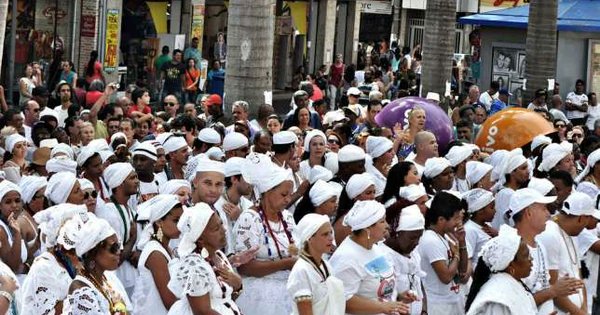
Yoruba Religion in Brazil: Candomblé
Brazil received more enslaved Africans than any other country in the Americas, and many of them were Yoruba.
In Brazil, Yoruba religious traditions evolved into what is now known as Candomblé.
Although Candomblé incorporates influences from several African ethnic groups, Yoruba traditions remain among its strongest foundations.
Within Candomblé:
* Olódùmarè is recognised as the Supreme Being. * The Òrìṣà remain central to worship. * Sacred drumming accompanies ceremonies. * Dance is used as an expression of devotion. * Ritual initiation continues. * Offerings and festivals remain important.
The city of Salvador, particularly the state of Bahia, became one of the most important centres of Afro-Brazilian religious life.
Yoruba Religion in Cuba: Lucumí and Santería
In Cuba, Yoruba traditions became known as the Lucumí religion, named after a term historically used for Yoruba-speaking people.
Over time, Lucumí developed into what is widely known today as Santería, or Regla de Ocha.
During the colonial period, practitioners often identified Òrìṣà with Roman Catholic saints. This was partly a strategy for preserving traditional worship under conditions where African religions were discouraged or prohibited.
For example:
* Sango became associated with Saint Barbara. * Yemoja became associated with the Virgin Mary in some traditions. * Osun was associated with Our Lady of Charity, Cuba's patron saint.
While these associations became part of Cuban religious history, practitioners generally understand the Òrìṣà and Catholic saints as distinct figures, even where they have been linked in ritual practice.
The Role of Music and Dance
Music became one of the strongest vehicles for preserving Yoruba spirituality.
Sacred drums such as the Batá drum, originally associated with Yoruba religious traditions, remain central to ceremonies throughout the Americas.
Songs are often performed in liturgical forms of the Yoruba language that have been preserved for generations, even by communities whose everyday language is now Portuguese, Spanish, or English.
Dance also plays an essential role, with each Òrìṣà having distinctive rhythms, movements, and ceremonial expressions.
The Survival of the Yoruba Language
Although most descendants of enslaved Yoruba people now speak the dominant languages of their countries, elements of the Yoruba language have survived remarkably well.
Many prayers, songs, ritual greetings, and sacred names remain recognisably Yoruba.
In Cuba, the liturgical language used in Lucumí ceremonies preserves numerous Yoruba words and expressions, though pronunciation and vocabulary have evolved over time.
This linguistic continuity is one of the clearest signs of the enduring influence of Yoruba civilisation.
Return Connections Between Africa and the Americas
The movement of culture was not one-way.
During the nineteenth century, some formerly enslaved Africans and their descendants returned to West Africa from Brazil, Cuba, and Sierra Leone.
These returnees, often known in Nigeria as Aguda, brought with them:
* Architectural styles. * New crafts. * Catholic traditions. * Business networks. * Elements of Brazilian and Afro-Atlantic culture.
Their influence can still be seen in parts of Lagos and other coastal cities, where distinctive Brazilian-style buildings remain.
Yoruba Religion Today
Today, Yoruba-inspired religious traditions are practised by millions of people across the world.
Communities can be found in:
* Brazil * Cuba * Trinidad and Tobago * Puerto Rico * Venezuela * The United States * Canada * The United Kingdom * Nigeria * Benin * Togo
Growing academic interest, cultural exchanges, and increased travel between West Africa and the Americas have strengthened ties between these communities.
Many practitioners now visit Yorubaland to learn more about the traditions from which their religions originated.
A Legacy of Resilience
The survival of Yoruba religion across the Atlantic is one of history's most powerful examples of cultural endurance.
Despite enslavement, displacement, and attempts to erase African identities, Yoruba beliefs continued to flourish.
They adapted without losing their essential foundations, proving that culture can survive even under the harshest conditions.
Today, Yoruba religious traditions continue to inspire millions of people and serve as a bridge connecting Africa with the African diaspora.
Conclusion
The spread of Yoruba religion to Brazil, Cuba, and the wider Americas is not simply a story of migration. It is a story of perseverance, adaptation, and cultural memory.
Carried across the Atlantic by enslaved Yoruba people, these traditions survived centuries of hardship and evolved into vibrant religious systems such as Candomblé in Brazil and \\Santería> in Cuba. They preserved Yoruba concepts of Olódùmarè, the Òrìṣà, sacred music, ritual, and community, while also reflecting the historical realities of life in the Americas.
Today, these traditions stand as living monuments to the resilience of the Yoruba people. They remind us that faith, culture, and identity can cross oceans, survive oppression, and continue to unite generations separated by continents but connected through a shared spiritual heritage.