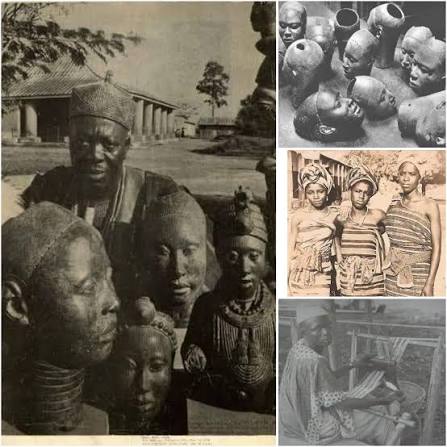
Introduction
When people hear the word "science," they often imagine modern laboratories, telescopes, computers, and universities. Yet long before the rise of modern scientific institutions, societies across the world developed sophisticated systems of knowledge based on observation, experimentation, classification, and practical experience.
The Yoruba civilisation of West Africa was no exception.
For centuries, Yoruba communities accumulated extensive knowledge about medicine, agriculture, metallurgy, architecture, mathematics, ecology, governance, and astronomy. Although this knowledge was not always recorded in the same way as European scientific traditions, it was carefully preserved through oral transmission, apprenticeship, and cultural institutions.
Understanding ancient Yoruba scientific knowledge requires moving beyond the misconception that science only exists when written in textbooks. The Yoruba developed methods of understanding and interacting with the natural world that enabled them to build thriving societies, manage resources, heal illnesses, and create enduring cultural achievements.
Their knowledge systems demonstrate that intellectual innovation has deep roots in Africa.
Science Before Modern Science
Modern science is characterised by formal experimentation, documentation, and peer review. Ancient societies, however, often relied on observation accumulated over generations.
The Yoruba gained knowledge through:
* Careful observation of nature * Practical experience * Oral instruction * Trial and error * Community memory * Specialist training
Knowledge was passed from experts to apprentices, ensuring continuity across generations.
Rather than separating science from everyday life, Yoruba society integrated knowledge directly into farming, healing, craftsmanship, and governance.
Ifá as a Knowledge System
One of the most remarkable intellectual traditions within Yoruba civilisation is Ifá.
Although often described primarily as a divination system, Ifá also functions as a vast repository of knowledge.
The Ifá corpus contains teachings relating to:
* Ethics * Medicine * Agriculture * Human behaviour * Conflict resolution * Ecology * Governance
Through the preservation of hundreds of thousands of verses, generations of scholars known as Babaláwo maintained an extensive body of accumulated wisdom associated with Orunmila.
Many scholars view Ifá as one of Africa's most sophisticated indigenous knowledge systems.
Indigenous Medicine and Healing
Long before the introduction of modern hospitals, Yoruba healers developed extensive knowledge of medicinal plants and natural remedies.
Traditional practitioners studied:
* Plant properties * Preparation methods * Dosages * Environmental conditions * Preventive healthcare
This knowledge was acquired through generations of observation and practical experience.
Many medicinal plants used in traditional Yoruba medicine continue to attract scientific interest today because of their potential pharmaceutical properties.
While traditional medicine and modern medicine are not identical, both share an interest in understanding health and treating illness.
Agricultural Knowledge and Environmental Management
Agriculture formed the foundation of Yoruba society.
Successful farming required detailed knowledge of:
* Rainfall patterns * Soil conditions * Seasonal changes * Crop rotation * Pest management * Land conservation
Farmers observed environmental indicators to determine planting and harvesting periods.
These practices helped sustain growing populations and supported the development of major urban centres across Yorubaland.
The survival of communities depended upon accurate environmental understanding.
Iron Technology and Metallurgy
One of the most impressive technological achievements of ancient Yoruba civilisation was ironworking.
Blacksmiths possessed specialised knowledge of:
* Ore processing * Furnace operation * Metal shaping * Tool production * Weapon manufacturing
Iron tools transformed agriculture, construction, trade, and warfare.
The cultural importance of metallurgy is reflected in the reverence shown towards Ogun, who is associated with iron, craftsmanship, innovation, and industry.
The success of Yoruba ironworking demonstrates a sophisticated understanding of materials and manufacturing techniques.
Mathematics and Numerical Thinking
Yoruba civilisation developed advanced numerical concepts that supported trade, administration, and knowledge systems.
The Yoruba counting system includes complex numerical structures that differ significantly from English.
In addition:
* Market transactions required calculation skills. * Land measurement required practical mathematics. * Architectural planning involved spatial reasoning. * Ifá contains intricate symbolic patterns that scholars have compared to mathematical structures.
The organisation of the 256 Odù Ifá demonstrates a remarkable degree of logical and combinatorial complexity.
Astronomy and Timekeeping
The Yoruba paid close attention to celestial movements and seasonal cycles.
Knowledge of:
* The sun * The moon * Seasonal changes * Weather patterns
helped regulate agriculture, festivals, and social activities.
Traditional Yoruba calendars were used to organise:
* Market cycles * Religious observances * Agricultural schedules * Community events
Although different from modern astronomy, these observations reflected systematic engagement with the natural world.
Architecture and Urban Planning
Yoruba cities were among the most developed urban centres in pre-colonial West Africa.
Cities such as Ile-Ife, Oyo, and Ijebu Ode displayed sophisticated planning.
Architectural knowledge included:
* Compound design * Ventilation techniques * Drainage systems * Defensive structures * Construction materials
These innovations enabled communities to adapt effectively to local environmental conditions.
Knowledge of Ecology and Conservation
Many Yoruba traditions reflected an understanding of environmental stewardship.
Sacred groves, protected forests, and cultural taboos often contributed to conservation efforts.
Places such as the Osun-Osogbo Sacred Grove preserved biodiversity through cultural protection mechanisms.
While these practices were rooted in spirituality, they also produced practical ecological benefits.
They demonstrate how environmental knowledge can be embedded within cultural systems.
Knowledge Transmission Through Apprenticeship
A key feature of Yoruba scientific knowledge was its method of transmission.
Experts trained apprentices in fields such as:
* Medicine * Blacksmithing * Sculpture * Farming * Textile production * Divination
Learning often involved years of practical instruction.
Knowledge was tested through performance rather than written examinations.
This apprenticeship model ensured that specialised skills survived across generations.
Modern Recognition of Indigenous Knowledge
Today, researchers increasingly recognise the value of indigenous knowledge systems.
Scholars study Yoruba traditions to better understand:
* Ethnobotany * Environmental management * Oral knowledge preservation * Traditional technologies * Indigenous philosophies of knowledge
Rather than viewing traditional and modern knowledge as opposites, many experts now explore how they can complement one another.
This growing interest reflects a broader recognition that scientific thinking has emerged in many forms across human history.
Conclusion
Ancient Yoruba civilisation developed a rich and sophisticated body of scientific knowledge long before the arrival of modern institutions. Through observation, experimentation, practical experience, and oral transmission, Yoruba communities accumulated expertise in medicine, agriculture, metallurgy, mathematics, astronomy, architecture, and environmental management.
Their achievements challenge outdated assumptions that science belongs exclusively to one civilisation or historical period.
Instead, the Yoruba experience reminds us that human curiosity is universal. Wherever people observed nature, solved problems, and passed knowledge to future generations, scientific thinking emerged.
The legacy of Yoruba knowledge systems continues to inspire researchers, cultural scholars, and communities today. It stands as a powerful testament to the intellectual creativity of one of Africa's great civilisations and to the many ways human beings have sought to understand the world around them.