Introduction
Few cultural journeys in human history are as remarkable as the survival of Yoruba spirituality in Brazil. Torn from their homeland through the horrors of the transatlantic slave trade, thousands of Yoruba men and women carried with them a spiritual tradition that refused to disappear. Although they lost their freedom, many refused to surrender their faith, their songs, their sacred rhythms, or their understanding of the divine.
Over generations, those beliefs took root in Brazil and evolved into Candomblé, one of the world's most vibrant Afro-descendant religions. While shaped by Brazil's unique social and historical circumstances, Candomblé retains unmistakable Yoruba foundations. Its reverence for the Òrìṣà, sacred drumming, ritual dance, initiation ceremonies, and oral traditions all bear witness to a heritage that has survived for centuries.
Today, Candomblé stands as both a religion and a living monument to the resilience of African civilisation.
The Arrival of the Yoruba in Brazil
Between the sixteenth and nineteenth centuries, Brazil received more enslaved Africans than any other country in the Americas.
Among them were large numbers of Yoruba-speaking people, many of whom were taken from present day southwestern Nigeria, Benin, and neighbouring regions during the nineteenth century. Political upheavals following the decline of the Old Oyo Empire and the Yoruba civil wars contributed to the capture and forced transportation of many people.
Most Yoruba captives arrived in the Brazilian state of Bahia, particularly in the city of Salvador, which would become the principal centre of Afro-Brazilian culture.
Although enslaved Africans came from many ethnic backgrounds, the influence of Yoruba religious traditions became especially prominent in Bahia.
What Is Candomblé?
Candomblé is an Afro-Brazilian religion that developed from the spiritual traditions of several West and Central African peoples, including the Yoruba, Fon, and Bantu. Within Candomblé, these traditions are organised into different ritual lineages, often called nações (nations), each preserving distinct liturgical customs.
The Ketu tradition, one of the most widespread forms of Candomblé, is rooted primarily in Yoruba religious heritage.
Like traditional Yoruba religion, Candomblé recognises:
* A Supreme Creator. * Divine beings who act as intermediaries. * Sacred rituals. * Ancestor reverence. * Music and dance as forms of worship. * Initiation into religious communities.
Rather than being a recreation of Yoruba religion, Candomblé is a Brazilian religion with deep Yoruba roots that has evolved over centuries.
Olódùmarè and the Òrìṣà
At the heart of Candomblé is belief in a Supreme Creator, understood in Yoruba tradition as Olódùmarè.
Daily worship, however, focuses largely on the Òrìṣà, divine beings who represent different aspects of creation and human experience.
Among the best-known Òrìṣà honoured in Candomblé are:
* Oxalá (Obàtálá), associated with creation, wisdom, and purity. * Xangô (Ṣàngó), associated with thunder, justice, and kingship. * Oxum (Ọ̀ṣun), associated with rivers, beauty, prosperity, and fertility. * Iemanjá (Yemọja), associated with motherhood, rivers, and, in Brazil, especially the sea. * Ogum (Ògún), associated with iron, technology, labour, and protection.
Although the names and certain ritual practices have changed over time, their Yoruba origins remain evident.
Music, Drumming, and Dance
Music is central to Candomblé worship.
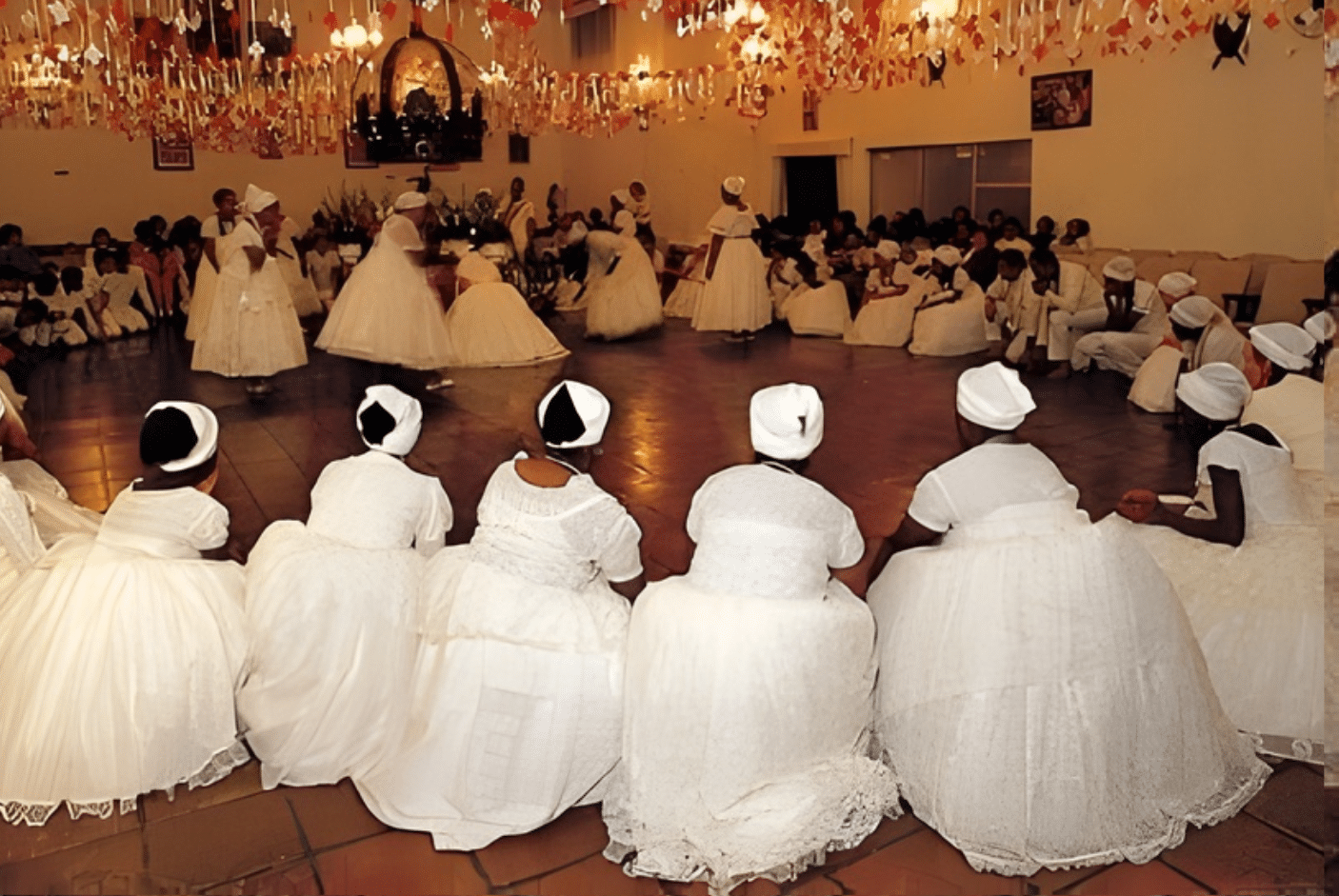
Ceremonies feature sacred drumming performed on atabaque drums, accompanied by chanting and carefully choreographed dance.
Each Òrìṣà has:
* Distinct rhythms. * Characteristic songs. * Traditional colours. * Symbolic movements. * Sacred attributes.
The dances are not simply performances. They are acts of devotion that express the qualities and presence of the Òrìṣà.
This close relationship between music, rhythm, and spirituality reflects one of the strongest continuities with Yoruba religious practice.
The Role of the Terreiro
The principal place of worship in Candomblé is the terreiro, a sacred community space where ceremonies, festivals, teaching, and initiation take place.
A terreiro is much more than a religious building. It is a centre of:
* Spiritual guidance. * Cultural preservation. * Education. * Community support. * Music and dance. * Oral tradition.
Many terreiros have existed for well over a century and continue to preserve rituals passed down through generations.
Language and Oral Tradition
One of the most remarkable aspects of Candomblé is its preservation of Yoruba language.
Although Portuguese is the everyday language of Brazil, many prayers, songs, greetings, and ceremonial expressions are still performed in liturgical Yoruba or in forms that preserve Yoruba vocabulary and pronunciation.
This linguistic continuity provides an important link between modern Brazil and ancestral Yorubaland.
The religion's emphasis on oral transmission has also helped preserve ancient traditions that might otherwise have disappeared.
Syncretism with Catholicism
During Brazil's colonial period, African religions faced persecution.
To protect their traditions, many practitioners outwardly associated certain Òrìṣà with Roman Catholic saints. This process, known as religious syncretism, allowed many rituals to continue despite official restrictions.
For example:
* Oxalá became associated with Jesus Christ in some traditions. * Xangô was linked with Saint Jerome or Saint John the Baptist in some regions. * Oxum became associated with Our Lady of the Conception. * Iemanjá was associated with Our Lady of the Seafarers and other Marian titles in different communities.
Today, the extent of this syncretism varies. Some Candomblé communities maintain Catholic associations, while others emphasise the distinct African identity of their religion.
Women as Guardians of Tradition
Women have played a vital role in preserving Candomblé.
Many of the religion's most respected leaders have been Mães de Santo (Mothers of the Sacred), priestesses responsible for guiding religious communities, preserving rituals, and training new generations.
Historic temples founded and led by women became centres of resistance during periods when African cultural traditions were suppressed.
Their leadership has ensured that Candomblé remains one of the strongest surviving expressions of African heritage in the Americas.
Candomblé in Modern Brazil
Today, Candomblé is practised throughout Brazil, with especially strong communities in Bahia, Rio de Janeiro, São Paulo, and Pernambuco.
Its influence extends beyond religion into:
* Music. * Dance. * Literature. * Visual arts. * Fashion. * Brazilian national identity.
Public celebrations, such as the annual Festival of Iemanjá, attract thousands of participants and visitors each year.
Although practitioners have at times faced discrimination, legal protections and growing public recognition have strengthened the preservation of Afro-Brazilian religious traditions.
A Bridge Between Africa and Brazil
In recent decades, cultural exchanges between Brazil and Yorubaland have grown significantly.
Priests, scholars, artists, and devotees frequently travel between Brazil and Nigeria to study shared traditions, participate in festivals, and strengthen historical ties.
These exchanges have deepened appreciation for the common heritage that links Afro-Brazilian communities with their ancestral homeland.
They also highlight the enduring global influence of Yoruba civilisation.
Conclusion
Candomblé is one of the most enduring legacies of the Yoruba people beyond Africa. Born from the trauma of enslavement yet sustained by extraordinary resilience, it transformed into a uniquely Brazilian religion while preserving many essential features of Yoruba spirituality.
Its reverence for Olódùmarè and the Òrìṣà, its sacred music and dance, its oral traditions, and its strong sense of community all testify to the strength of a culture that refused to disappear.
Today, Candomblé is more than a religion. It is a living archive of memory, identity, and resistance. It reminds us that although people may be forced across oceans, their beliefs, values, and cultural heritage can endure, adapt, and continue to inspire generations far from the land where they first took root.