Introduction
The Egúngún festival is one of the most sacred, colorful, and spiritually significant traditions in Yoruba culture. Deeply rooted in ancestral reverence, the festival represents the belief that the dead are never truly separated from the living. Instead, ancestors continue to guide, protect, warn, and bless their descendants from the spiritual realm.
Across Yorubaland, Egúngún celebrations combine spirituality, performance, music, dance, costume artistry, and communal identity into a powerful cultural experience that has survived for centuries. Beyond entertainment, the festival reflects Yoruba ideas about family lineage, morality, memory, and the ongoing relationship between the physical and spiritual worlds.
What Is Egúngún?
Egúngún refers both to ancestral masquerades and to the spiritual tradition surrounding ancestral veneration in Yoruba culture.
The word “Egúngún” is commonly associated with masked performers believed to embody or represent ancestral spirits temporarily returning to the world of the living during ceremonial festivals. (en.wikipedia.org)
In Yoruba belief, ancestors remain spiritually active members of the community even after death. They are honored because they:
* Preserve family lineage * Protect descendants * Offer wisdom and guidance * Punish immoral behavior * Maintain spiritual balance
The Egúngún festival creates a symbolic bridge between the visible world (Ayé) and the spiritual realm (Òrun).
Yoruba Beliefs About Ancestors
In Yoruba spirituality, death is not viewed as total disappearance but as a transition into another level of existence.
Ancestors are respected members of the spiritual community who continue to influence earthly life. However, not everyone automatically becomes an honored ancestor.
Traditionally, ancestors worthy of reverence were expected to have lived lives marked by:
* Good character * Moral discipline * Family responsibility * Social contribution * Spiritual integrity
This belief connects closely with the Yoruba concept of Ìwà Pẹ̀lẹ́ — gentle and honorable character.
The Egúngún tradition therefore reinforces moral behavior by reminding communities that one’s legacy continues beyond death.
Origins of the Egúngún Tradition
The origins of Egúngún traditions extend far back into Yoruba history and oral tradition.
Different Yoruba towns and lineages preserve unique stories explaining how ancestral masquerade practices began. Many traditions trace the system to early Yoruba religious and royal institutions connected to ancestor veneration and spiritual authority. (britannica.com)
Over centuries, Egúngún festivals evolved into highly organized ceremonial events involving:
* Family lineages * Priesthoods * Drummers * Costume makers * Dancers * Community leaders
The tradition spread across Yorubaland and later into parts of the African diaspora through migration and the transatlantic slave trade.
The Egúngún Masquerade Costume
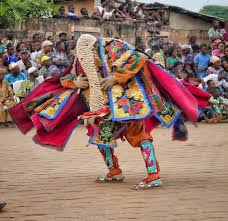
One of the most striking aspects of the festival is the elaborate masquerade costume.
Egúngún garments are often made from layers of richly colored cloth, embroidered fabrics, charms, beads, and symbolic decorations. The costumes are designed to completely conceal the identity of the wearer.
When the masquerade appears publicly, the performer is no longer viewed merely as a human being but as a sacred representative of ancestral presence.
The swirling movement of the layered cloth during dances is believed to demonstrate spiritual energy and power.
Some costumes are passed down through generations as treasured family heirlooms connected to ancestral lineage.
Music, Dance, and Performance
Music and dance are central elements of Egúngún festivals.
Traditional instruments commonly used include:
* Talking drums * Bata drums * Dundun drums * Gongs * Rattles
Drumming patterns communicate praise, ancestral messages, and ceremonial rhythms.
Masquerades perform dramatic dances involving spinning, jumping, acrobatics, and symbolic gestures. Some performances are humorous, while others are solemn and spiritually intense.
Praise singers often recite family histories, heroic deeds, and ancestral achievements during ceremonies.
These performances preserve oral history and strengthen communal identity.
Spiritual Functions of Egúngún
The Egúngún tradition serves several spiritual and social purposes.
Ancestral Blessing
Families seek blessings, protection, fertility, prosperity, and guidance from ancestral spirits during festivals.
Moral Enforcement
In some communities, Egúngún masquerades traditionally acted as moral authorities who publicly criticized wrongdoing and encouraged proper conduct.
Conflict Resolution
Festivals sometimes helped restore peace and unity within communities by reinforcing shared cultural values and family connections.
Preservation of Heritage
The ceremonies protect and transmit Yoruba spiritual knowledge, music, dance, textile art, and oral traditions across generations.
Types of Egúngún Performances
Different Yoruba towns maintain distinct Egúngún traditions and masquerade styles.
Some masquerades are:
* Royal and dignified * Fierce and spiritually powerful * Entertaining and comedic * Acrobatic and energetic * Protective and ritualistic
Famous Egúngún festivals take place in places such as:
* Oyo * Ibadan * Abeokuta * Ile-Ife
Each region preserves unique ceremonial customs and artistic expressions.
Egúngún and the African Diaspora
Through the transatlantic slave trade, Yoruba ancestral traditions spread to the Americas and Caribbean.
Elements of Egúngún traditions influenced spiritual practices in:
* Brazil * Cuba * Trinidad and Tobago * Haiti
In some diaspora communities, ancestral masquerade traditions survived in modified forms despite colonial suppression.
Today, African diaspora practitioners continue to study and preserve Yoruba ancestral spirituality globally.
Misunderstandings and Colonial Attitudes
During colonial rule and missionary expansion, many African spiritual traditions were misunderstood or unfairly condemned.
Egúngún practices were often wrongly portrayed as superstition or idol worship without recognition of their philosophical and cultural significance.
Modern scholars now increasingly recognize Egúngún as:
* A sacred ancestral tradition * A system of social ethics * A form of performance art * A cultural archive * A spiritual philosophy
Anthropologists and historians study Egúngún festivals as important examples of African religious and artistic sophistication.
Egúngún Festivals in Modern Times
Today, Egúngún festivals remain vibrant across many Yoruba communities.
They continue to attract:
* Local worshippers * Tourists * Historians * Cultural enthusiasts * Photographers * Researchers
Modern celebrations often combine spiritual devotion with cultural tourism and heritage preservation.
Social media and digital platforms have also helped introduce Egúngún traditions to global audiences interested in African spirituality and culture.
Philosophical Meaning of Egúngún
At its deepest level, Egúngún reflects the Yoruba understanding that life is continuous and interconnected.
The tradition teaches that:
* Ancestors remain spiritually present * Communities are linked across generations * Memory preserves identity * Moral behavior shapes legacy * The living carry responsibility toward both past and future generations
The festival therefore becomes not only a religious ceremony but also a reflection on humanity, remembrance, continuity, and cultural survival.
Conclusion
Egúngún festivals stand among the most powerful expressions of Yoruba spirituality and cultural identity. Through ancestral masquerades, music, dance, and ritual performance, the Yoruba people celebrate the enduring relationship between the living and the dead.
Far beyond spectacle alone, Egúngún traditions preserve history, strengthen family bonds, reinforce moral values, and affirm the belief that ancestors continue to guide the community from the spiritual realm.
Even in the modern world, the festival remains a living symbol of Yoruba heritage, resilience, and spiritual philosophy.