Introduction
Today, Abeokuta is known as the capital of Ogun State, home to the famous Olumo Rock and one of the most historically significant cities in Yorubaland. Yet the city was not founded by a single king, nor did it emerge through gradual expansion over centuries. Instead, Abeokuta was born out of crisis.
During the nineteenth century, Yorubaland was engulfed in a series of wars and political upheavals. Entire communities were destroyed, thousands were displaced, and people sought safe havens where they could rebuild their lives. Out of this period of uncertainty emerged Abeokuta, a city that would become a symbol of survival, unity, and resistance.
Its story is not merely one of migration. It is the story of how diverse groups came together under difficult circumstances and transformed a rocky landscape into one of the most important cities in Yoruba history.
The Collapse of the Old Order
The early nineteenth century was marked by widespread instability.
The decline of the Old Ọ̀yọ́ Empire weakened political authority across Yorubaland. At the same time, internal conflicts, the Owu War, raids from Dahomey, and military campaigns connected to Ilorin and the Sokoto Caliphate created a climate of fear and insecurity.
Communities that had once prospered were devastated. Families abandoned ancestral homes, searching for places where they could live in peace and defend themselves against further attacks.
Among those affected were various Egba groups who had previously occupied settlements around present-day Oyo and other regions.
The Egba Migrations
The Egba people are made up of several major divisions, including:
* Ake * Oke-Ona * Gbagura * Owu
These groups had experienced repeated disruptions and displacement during the wars.
Seeking security, they moved southwards under the leadership of respected chiefs and warriors. Their journey eventually brought them to an area characterised by massive rock formations and natural defensive features.
This location would become known as Abeokuta.
The Meaning of Abeokuta
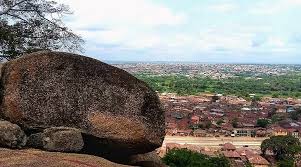
The name Abeokuta comes from the Yoruba expression "Abẹ́ Òkúta," meaning "under the rock."
The name reflected the geography of the settlement.
The enormous rocks, especially what is now known as Olumo Rock, provided natural protection against enemies.
For people fleeing warfare, these rocks represented more than physical shelter. They symbolised hope, safety, and a fresh beginning.
Olumo Rock and the Defence of the City
Olumo Rock played a crucial role in the survival of the early settlement.
From its heights, inhabitants could observe approaching enemies and prepare their defences. The surrounding terrain made direct attacks difficult.
The rock also became associated with spiritual significance and communal identity.
According to tradition, individuals such as Lisabi's descendants and prominent Egba leaders regarded the area as a providential refuge. Over time, Olumo Rock became not only a military asset but also a symbol of unity among the various Egba groups.
A City of Many Peoples
Unlike some Yoruba cities founded around a single dynasty, Abeokuta was formed through the coming together of different groups.
The settlement included:
* Ake communities * Oke-Ona communities * Gbagura communities * Owu refugees * Other migrants seeking safety
Despite their different origins, they developed a shared identity based on mutual protection and cooperation.
This spirit of unity became one of the defining characteristics of Abeokuta.
Resisting External Threats
Abeokuta soon proved that it was more than a refugee camp.
During the nineteenth century, the city faced repeated threats, particularly from the Kingdom of Dahomey under King Ghezo.
The Egba successfully resisted these invasions, most notably during the battles of 1851 and 1864.
These victories strengthened Abeokuta's reputation and demonstrated the determination of its people to defend their hard-won sanctuary.
Economic Growth and Foreign Contacts
As stability improved, Abeokuta developed into a thriving commercial centre.
Trade expanded, attracting merchants and visitors from various regions.
The city also became an important destination for Christian missionaries and liberated Africans returning from Sierra Leone and Brazil. These returnees brought new ideas, educational institutions, and architectural influences that contributed to the city's growth.
Abeokuta eventually became one of the first centres of Western education and Christianity in southwestern Nigeria.
Political Development
Over time, the Egba communities developed a more organised political system.
The office of the Alake of Egbaland emerged as an important institution, while councils of chiefs continued to play significant roles in governance.
Abeokuta became one of the most politically influential cities in Yorubaland and later contributed significantly to the nationalist movements that shaped modern Nigeria.
It would eventually produce notable figures such as Funmilayo Ransome-Kuti and Olusegun Obasanjo.
Legacy of a Refugee City
The story of Abeokuta is one of resilience and adaptation.
What began as a sanctuary for displaced people evolved into a major centre of commerce, politics, education, and culture.
The city remains a reminder that communities can emerge stronger from adversity when united by shared purpose and mutual support.
Its history reflects the broader story of the Yoruba people, a people who have repeatedly demonstrated the ability to rebuild, preserve their identity, and transform hardship into opportunity.
Conclusion
Abeokuta became a refugee city because of war, displacement, and the search for security. Yet it grew into much more than a place of shelter.
Protected by the rocks that gave it its name and strengthened by the unity of its people, Abeokuta transformed into one of the most influential cities in Yorubaland.
Its history illustrates that even in times of chaos, human beings possess the capacity to create new beginnings. From the safety found beneath the rocks emerged a city whose influence continues to be felt across Nigeria and beyond.
The story of Abeokuta stands as a powerful testimony to endurance, unity, and the enduring spirit of the Yoruba people.