Introduction
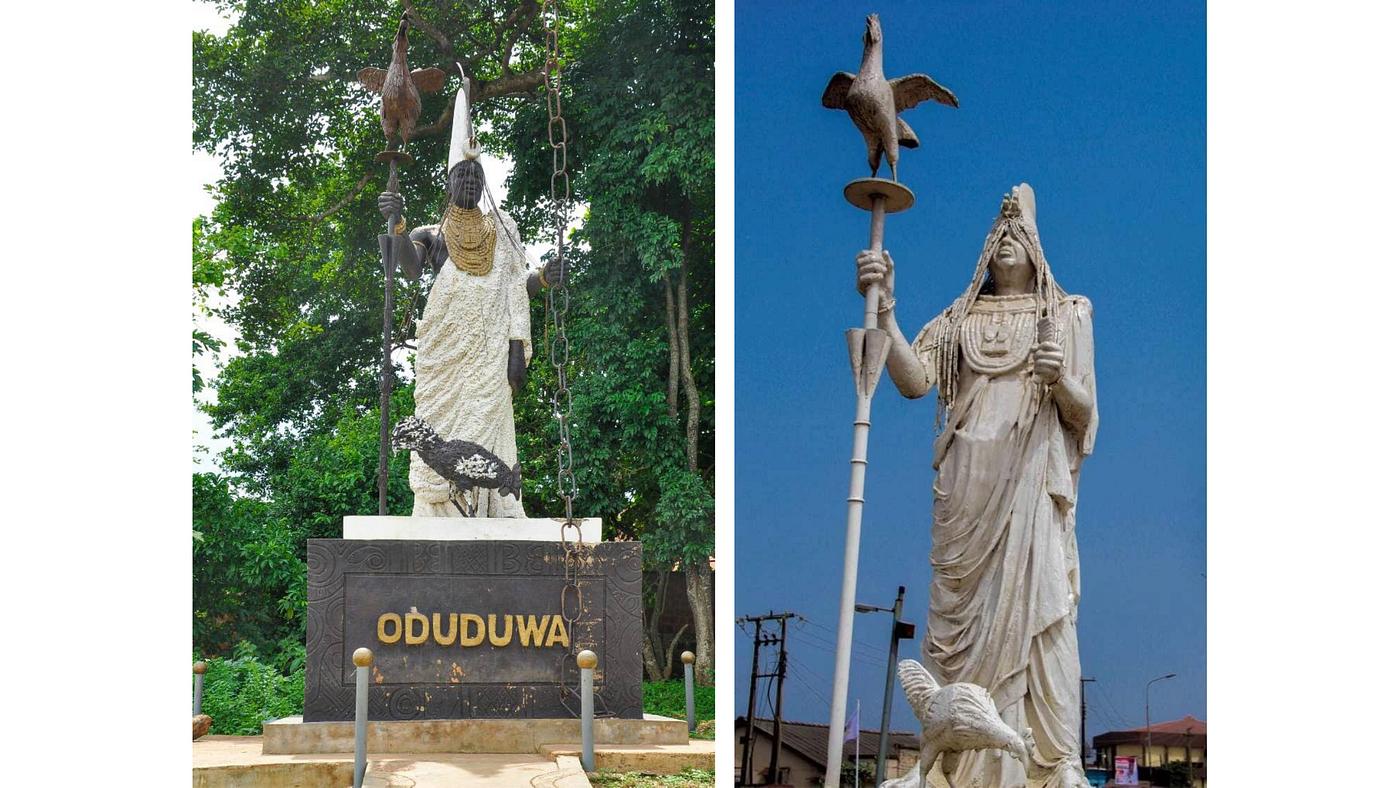
Few figures occupy a more important place in Yoruba history, culture, and identity than Oduduwa. Across Yorubaland and throughout the Yoruba diaspora, Odùduwà is revered as the ancestral founder from whom many Yoruba kingdoms trace their origins.
Yet historians, archaeologists, and scholars have long debated a fascinating question: Was Odùduwà a real historical individual who lived in the distant past, or does he represent a symbolic figure embodying the origins and unity of the Yoruba people?
The answer is complex. Odùduwà exists at the intersection of history, mythology, oral tradition, politics, and cultural memory. Whether viewed as a historical ruler, a legendary ancestor, or a symbolic founder, his importance to Yoruba civilization is undeniable.
Odùduwà in Yoruba Oral Tradition
According to Yoruba oral traditions, Odùduwà is regarded as the founding ruler of Ile-Ife, often considered the spiritual homeland of the Yoruba people.
Many traditions describe him as the ancestor of numerous Yoruba royal families. Several important Yoruba kingdoms, including Oyo, Ijebu, Ketu, Ondo, Ekiti, and others, trace their dynasties back to Odùduwà through his children or descendants.
Because of this ancestral connection, many Yoruba monarchs still maintain genealogies linking their royal houses to him.
In Yoruba historical consciousness, Odùduwà serves as a unifying figure whose descendants spread across the region and established many of the kingdoms that would later become major political centers.
The Creation Narrative
In one well-known Yoruba creation account, the world was initially covered by water. Under the authority of the Supreme Being, Olódùmarè, Odùduwà descended from the heavens carrying sacred materials that would be used to create habitable land.
Using these items, land emerged at Ile-Ife, which became the first center of human civilization in Yoruba tradition.
This narrative is primarily spiritual and symbolic rather than historical. It explains the sacred status of Ile-Ife and establishes its importance as the origin point of Yoruba civilization.
For many Yoruba people, the story is not merely a literal account of creation. It expresses deeper truths about origins, identity, divine order, and the sacred nature of their homeland.
Ile-Ife and Archaeological Evidence
Archaeological discoveries reveal that Ile-Ife was one of Africa's most remarkable urban centers long before European contact.
Researchers have uncovered:
* Sophisticated bronze and terracotta sculptures * Advanced artistic traditions * Urban development and organized settlements * Evidence of extensive trade networks
These findings demonstrate that Ile-Ife was already a flourishing civilization centuries ago.
However, archaeology has not produced direct evidence confirming the existence of a specific individual named Odùduwà. Instead, it confirms that the city associated with him was an important political, religious, and cultural center.
This leaves open the possibility that Odùduwà may represent a remembered historical ruler whose story expanded over generations through oral tradition.
Historical Interpretations
Many scholars believe Odùduwà may have been an actual leader who played a significant role during a formative period in Yoruba history.
According to this interpretation, a powerful ruler or dynasty may have helped unify various communities around Ile-Ife. Over centuries, memories of this leadership could have evolved into the larger-than-life figure celebrated today.
Others suggest that Odùduwà symbolizes a migration, political transformation, or cultural unification rather than a single person.
In this view, Odùduwà functions much like legendary founders found in many civilizations around the world. Such figures often represent the birth of a people or nation rather than serving as strictly documented historical individuals.
Odùduwà as a Symbol of Yoruba Unity
Regardless of the historical debate, Odùduwà remains one of the strongest symbols of Yoruba identity.
His story helps connect diverse Yoruba subgroups spread across:
* Nigeria * Benin Republic * Togo * The global Yoruba diaspora
The idea of shared descent from Odùduwà provides a common cultural narrative that reinforces collective identity despite regional differences.
For centuries, this shared ancestry has helped strengthen cultural continuity and historical consciousness among Yoruba communities.
Odùduwà in Politics and Kingship
The legacy of Odùduwà continues to influence Yoruba kingship traditions today.
The Ooni of Ife is widely regarded as one of the most important custodians of Yoruba heritage because of Ile-Ife's association with Odùduwà.
Many Yoruba royal houses continue to emphasize their genealogical links to him, reinforcing their historical legitimacy and cultural authority.
As a result, Odùduwà remains both a spiritual ancestor and a political symbol within traditional institutions.
Myth, History, and Cultural Truth
Modern discussions often attempt to separate myth from history, but in many African societies the relationship between the two is more nuanced.
Oral traditions may preserve historical memories while also expressing spiritual beliefs, moral lessons, and cultural values.
Whether Odùduwà was a single historical individual, a dynasty, a symbolic ancestor, or a combination of all three, his story carries immense cultural significance.
The question is therefore not only whether Odùduwà existed in a strictly historical sense, but also what his story has meant to generations of Yoruba people.
Conclusion
Odùduwà occupies a unique place between legend and history. Archaeological evidence confirms the ancient greatness of Ile-Ife, while oral traditions preserve the memory of a founding ancestor who shaped the destiny of the Yoruba people.
Historians may continue to debate whether Odùduwà was a specific historical ruler or a symbolic representation of Yoruba origins. Yet his importance transcends that debate.
For millions of Yoruba people, Odùduwà represents ancestry, civilization, leadership, continuity, and cultural unity. His story remains one of the foundational narratives of Yorubaland and continues to inspire pride and identity across generations.
In the end, Odùduwà may be understood not only as a person from the past, but as a living symbol of the enduring spirit of the Yoruba people.