Introduction
Among the many political relationships that shaped pre-colonial Yorubaland, few were as influential as the rivalry between the Ijebu Kingdom and the Old Oyo Empire. For centuries, these two powerful Yoruba states competed for influence, trade, and regional authority. Their relationship alternated between peaceful cooperation, diplomatic negotiation, and military confrontation, reflecting the changing political realities of the time.
Despite periods of conflict, the rivalry was never rooted in ethnic differences. Both kingdoms belonged to the wider Yoruba civilisation, shared closely related languages, traditions, and religious beliefs, and traced aspects of their heritage to common ancestral traditions centred on Ile-Ife. Their competition was driven primarily by politics, economics, and the desire to protect their independence.
The story of the Ijẹ̀bú–Oyo rivalry reveals how powerful kingdoms can compete while still sharing a common cultural identity.
Two Powerful Yoruba Kingdoms
By the seventeenth and eighteenth centuries, both kingdoms had become major powers, but they developed in different ways.
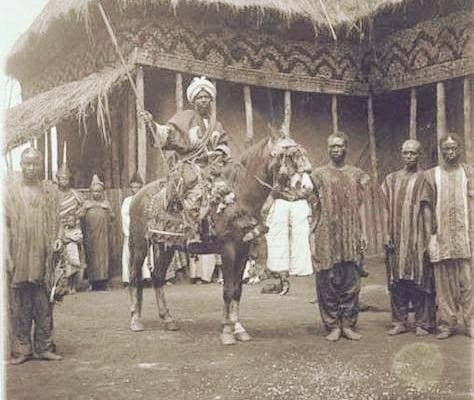
The Old Oyo Empire grew into one of West Africa's largest inland empires. Its strength rested on:
* A powerful cavalry. * Well-organised government. * Military expansion. * Tribute from subordinate territories. * Control of inland trade routes.
The Ijebu Kingdom, centred on Ijebu Ode, developed as a prosperous commercial state.
Its influence came largely from:
* Trade. * Skilled diplomacy. * Strategic geography. * Strong local administration. * Control of routes linking the interior to the Atlantic coast.
These different strengths naturally brought the two kingdoms into competition.
Competition for Trade
Trade lay at the heart of the rivalry.
Merchants travelling between the northern savannah, the forests of Yorubaland, and the Atlantic coast often passed through territories controlled by either Oyo or Ijẹ̀bú.
The Ijẹ̀bú controlled important commercial routes leading towards coastal trading centres, allowing them to:
* Collect tolls. * Regulate commerce. * Protect merchants. * Strengthen their economy.
Meanwhile, Oyo sought to expand its influence over regional trade networks to support its growing empire.
This competition for economic advantage frequently created political tension.
The Question of Political Independence
Unlike many neighbouring territories, Ijẹ̀bú strongly defended its political independence.
The rulers of Oyo regarded themselves as leaders of the most powerful Yoruba empire and sought influence over surrounding states.
The Awujale and his chiefs, however, resisted becoming subordinate to Oyo.
This disagreement centred on questions such as:
* Political sovereignty. * Tribute. * Diplomatic recognition. * Control of border territories.
Rather than accepting outside authority, Ijẹ̀bú maintained its own institutions and policies.
Military Confrontations
The rivalry occasionally resulted in armed conflict.
Although Oyo enjoyed military advantages through its famous cavalry, the forested terrain surrounding Ijẹ̀bú reduced the effectiveness of mounted warfare.
Ijẹ̀bú forces relied upon:
* Defensive fortifications. * Knowledge of local terrain. * Well-organised infantry. * Strategic alliances.
Neither kingdom achieved permanent domination over the other.
Instead, periods of conflict were often followed by negotiation and renewed commercial relations.
Diplomacy Alongside Rivalry
Despite their competition, Oyo and Ijẹ̀bú frequently engaged in diplomacy.
They exchanged:
* Envoys. * Gifts. * Trade agreements. * Political messages.
Shared cultural values often made negotiation possible even after periods of military tension.
Like many neighbouring states throughout history, rivalry did not prevent cooperation when mutual interests aligned.
Shared Yoruba Heritage
The rivalry should never be mistaken for a rejection of shared identity.
Both kingdoms:
* Spoke closely related forms of the Yoruba language. * Honoured many of the same Òrìṣà. * Celebrated similar festivals. * Practised related customs. * Preserved traditions linking them to Ile-Ife.
Political competition existed within a broader framework of cultural unity.
This shared heritage helped preserve Yoruba civilisation despite centuries of shifting political alliances.
The Coming of Colonial Rule
During the nineteenth century, new challenges transformed the political landscape.
The decline of the Old Oyo Empire, the Yoruba civil wars, expanding European trade, and eventually British colonial intervention altered the balance of power.
The Ijebu Expedition marked the end of Ijẹ̀bú's independence, while the remaining Yoruba kingdoms gradually came under British colonial administration.
With colonial rule, the old political rivalry lost much of its practical significance.
Lessons from the Rivalry
The history of the Ijẹ̀bú–Oyo rivalry offers several important lessons.
It reminds us that:
* Competition can exist without destroying cultural unity. * Economic interests often shape political relationships. * Strong institutions help preserve independence. * Diplomacy is as important as military strength. * Shared heritage can endure despite political disagreements.
Rather than viewing the rivalry as a story of enemies, it is better understood as a contest between two capable Yoruba states seeking to protect their own interests.
Conclusion
The rivalry between the Ijebu Kingdom and the Old Oyo Empire was one of the defining political relationships in pre-colonial Yorubaland. Driven by competition over trade, political influence, and regional authority, it shaped diplomacy, commerce, and military strategy for generations. Yet beneath this rivalry lay a deep cultural bond. Both kingdoms belonged to the same Yoruba civilisation, shared common traditions, and contributed immensely to its growth and resilience.
Today, the story of the Ijẹ̀bú–Oyo rivalry stands as a reminder that history is rarely a simple tale of friends and foes. It is a story of ambitious states navigating the challenges of power while remaining connected by a shared language, culture, and ancestral heritage. Their legacy continues to enrich our understanding of Yoruba history and the remarkable political sophistication of pre-colonial Africa.