Introduction
Long before cities rose from the earth, before kings sat upon their thrones, and before humanity filled the world with laughter, labour, and stories, the universe was still young.
The land had already emerged from the waters. Rivers flowed across valleys, forests stretched towards the horizon, and the earth was ready to receive life. Yet something was missing.
The world was beautiful, but it was empty.
There were no villages. No families. No songs carried by the wind. No footsteps upon the soil.
Seeing this, Olódùmarè, the Supreme Creator, decided that the earth should be inhabited by beings capable of thought, creativity, and purpose.
The sacred responsibility for this extraordinary task would be given to one of the most revered Òrìṣà in Yoruba tradition: Obatala.
Thus began one of the most cherished stories in Yoruba cosmology: the creation of humanity.
The Chosen Creator
Among all the Òrìṣà who served Olódùmarè, Ọbàtálá was known for his wisdom, patience, and calm nature.
He was respected throughout the heavenly realm for his purity of heart and his commitment to justice and compassion.
Where others displayed great strength or fiery power, Ọbàtálá possessed something equally important: wisdom and careful judgment.
Because of these qualities, Olódùmarè entrusted him with a task unlike any other.
He was to shape the first human beings.
It was an honour that carried immense responsibility, for the future of life on earth rested in his hands.
The Clay of the Earth
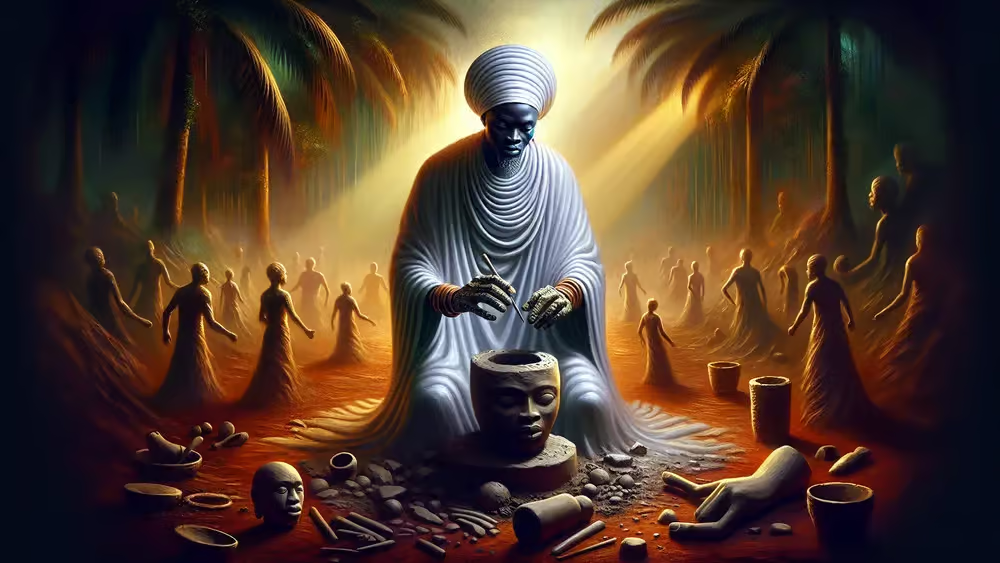
Ọbàtálá descended to the newly formed earth and searched for suitable material.
Eventually, he found clay.
It was soft and malleable, capable of taking any shape he desired.
Gathering the clay carefully, he began to work.
With the patience of a master sculptor, he moulded heads, arms, hands, legs, and feet. Every detail received careful attention. Each figure was unique, carrying its own identity and character.
One by one, the forms of human beings emerged beneath his skilled hands.
Yet despite their beauty, they remained motionless.
Their eyes could not see.
Their lungs could not breathe.
Their hearts could not beat.
For although Ọbàtálá could shape the body, only Olódùmarè possessed the power to create life itself.
The Breath of Life
When the figures were complete, Ọbàtálá presented them before Olódùmarè.
The Supreme Creator looked upon the clay forms with approval.
Then came a moment unlike any other.
Olódùmarè breathed the sacred force of life into the figures.
Their chests rose.
Their eyes opened.
Their hearts began to beat.
The first human beings stood upon the earth.
They looked around in wonder at the world that surrounded them.
The forests, rivers, animals, and skies were no longer empty.
Humanity had arrived.
The earth now possessed caretakers, dreamers, builders, and storytellers.
Life had truly begun.
A Lesson in Imperfection
One of the most important and meaningful parts of the story concerns a moment of imperfection.
According to Yoruba tradition, while shaping some of the human forms, Ọbàtálá became distracted. As a result, a number of the figures were created differently from others.
Some were born with physical disabilities or unique characteristics.
When Ọbàtálá realised what had happened, he felt deep sorrow.
However, Olódùmarè reminded him that every human being possesses value and dignity regardless of appearance or physical condition.
From that moment onward, Ọbàtálá became a special protector of people living with disabilities and those who were often overlooked by society.
This aspect of the story carries a profound message.
Human diversity is not a mistake.
Every person is worthy of respect, compassion, and inclusion.
For many generations, Yoruba tradition has used this story to encourage kindness towards all people, regardless of their differences.
Why White Is Sacred to Ọbàtálá
Because of his association with purity and wisdom, the colour white became closely connected to Ọbàtálá.
In many traditions, white symbolises:
* Peace * Purity * Truth * Clarity * Wisdom
Followers often wear white garments during ceremonies dedicated to him.
The colour serves as a reminder of the virtues that Ọbàtálá represents and the importance of living with honesty, self-control, and compassion.
Humanity's Sacred Responsibility
The story does not end with the creation of human beings.
According to Yoruba philosophy, humanity was created with purpose.
People were not placed upon the earth merely to exist. They were expected to:
* Live honourably * Respect others * Care for their communities * Fulfil their destinies * Maintain harmony with creation
The gift of life carried responsibilities as well as privileges.
This belief became one of the foundations of the Yoruba ideal of Omolúàbí — a person of good character, integrity, humility, and wisdom.
In this way, the story of creation is also a story about how life should be lived.
The Legacy of Ọbàtálá
For centuries, Ọbàtálá has remained one of the most respected figures in Yoruba spirituality.
He is remembered as:
* The sculptor of humanity * The symbol of wisdom and purity * The protector of the vulnerable * The advocate of peace and justice
His story continues to be told throughout Yorubaland and across Yoruba diaspora communities in Brazil, Cuba, the Caribbean, Europe, and the Americas.
Each retelling preserves not only a creation narrative but also a set of moral teachings about compassion, dignity, and human worth.
The Deeper Meaning of the Story
Like many ancient traditions, the story of Ọbàtálá and the creation of humanity contains lessons that extend beyond the literal narrative.
It teaches that life is sacred.
It teaches that diversity is part of the human experience.
It teaches that wisdom and patience are powerful virtues.
Most importantly, it reminds us that every person, regardless of status, appearance, or ability, possesses inherent value.
These lessons have helped shape Yoruba philosophy for generations and continue to resonate in the modern world.
Conclusion
The story of Ọbàtálá and the creation of humanity is one of the most beloved narratives in Yoruba tradition. It tells of a wise divine being entrusted with shaping the first people from clay and of Olódùmarè, whose breath transformed lifeless forms into living souls.
More than a tale about the origins of humanity, it is a story about compassion, dignity, responsibility, and the sacredness of life itself.
Through the patient hands of Ọbàtálá and the life-giving power of Olódùmarè, humanity came into existence. And through the lessons embedded in this ancient story, generations have learned that true greatness is measured not by power or wealth, but by wisdom, kindness, and respect for all people.
In the end, the story reminds us that every human being carries within them something divine: the breath of life itself.