Introduction
Long before the rise of mighty kingdoms such as Oyo Empire, before traders travelled ancient roads across West Africa, and before storytellers gathered beneath the moonlit sky to share tales of heroes and gods, the Yoruba people sought to answer one of humanity's oldest questions:
What lies beyond the world we can see?
The answer they found gave birth to one of the most profound ideas in Yoruba spirituality and philosophy: the existence of two interconnected realms known as Òrún and Ayé.
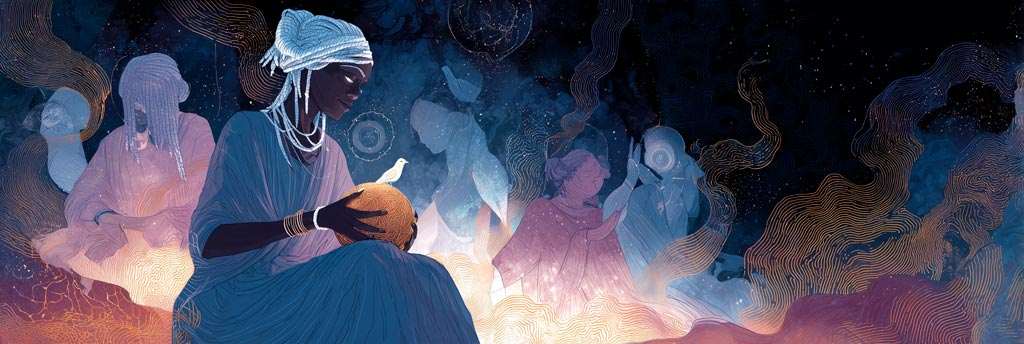
According to Yoruba tradition, existence is not limited to the physical world. Reality is divided into two great realms. One is visible and tangible. The other is invisible yet ever present. Together, they form a complete universe in which the spiritual and physical constantly interact.
This is the story of Òrún and Ayé, the two realms of existence.
Before the Beginning
In the earliest age, before human beings walked the earth and before the first kingdoms were founded, there existed only the divine realm.
This sacred realm was known as Òrún.
Òrún was the dwelling place of Olódùmarè, the Supreme Creator, and the home of countless spiritual beings. It was a place beyond time as humans understand it, where divine wisdom, destiny, and spiritual power originated.
Within Òrún lived the Òrìṣà, the divine custodians entrusted with various responsibilities throughout creation. There also existed the spirits of ancestors and souls awaiting their journey into the world of the living.
Although filled with life and purpose, Òrún was not intended to remain separate forever from the physical universe.
Olódùmarè had a greater plan.
The Creation of Ayé
According to Yoruba tradition, the physical world known as Ayé did not always exist.
At first, below the heavens stretched only an endless expanse of water.
When the time came for creation, Olódùmarè commanded that land should emerge from the waters. Through the efforts of divine beings such as Oduduwa and Obatala, the earth began to take shape.
Mountains rose.
Rivers formed.
Forests spread across the land.
Animals appeared.
Eventually, human beings were created and given life.
Thus Ayé, the realm of physical existence, came into being.
Yet Ayé was never intended to exist independently.
It remained forever connected to Òrún.
Two Worlds, One Reality
The Yoruba understanding of existence does not view Òrún and Ayé as separate universes.
Rather, they are two dimensions of the same reality.
Ayé is the world of human experience. It is where people are born, work, marry, raise families, and eventually die.
Òrún is the spiritual realm. It is where divine forces reside, where ancestors continue their existence, and where souls originate before entering the world.
The boundary between these realms is not considered absolute.
Instead, communication and influence constantly flow between them.
Dreams, prayers, blessings, divination, rituals, and spiritual experiences are often understood as points of connection between Òrún and Ayé.
For the Yoruba, the visible world is only one part of a much larger reality.
The Journey of the Soul
One of the most beautiful aspects of Yoruba philosophy concerns the journey of the soul.
Before birth, it is believed that every soul exists in Òrún.
There, the soul appears before Olódùmarè and chooses a destiny known as Àyànmọ́. This destiny contains the opportunities, challenges, lessons, and purpose that will shape the individual's life.
After making this choice, the soul enters Ayé through birth.
Upon entering the physical world, however, the memory of that pre-birth experience becomes hidden.
Life then becomes a journey of discovering and fulfilling one's chosen destiny.
When a person dies, the soul returns to Òrún, completing the cycle that began before birth.
Death, therefore, is not viewed as an end but as a transition from one realm to another.
The Role of the Ancestors
In Yoruba thought, ancestors do not simply disappear after death.
Those who lived honourable lives and fulfilled their responsibilities continue their existence within Òrún.
From there, they remain connected to their descendants.
Ancestors are regarded as guardians of family traditions, sources of wisdom, and spiritual protectors.
This belief explains why remembrance of ancestors occupies an important place in Yoruba culture.
Family histories, praise poetry, and traditional ceremonies help maintain the connection between generations living in Ayé and those who now reside in Òrún.
The relationship between the living and the departed is viewed as ongoing rather than broken.
The Òrìṣà as Messengers Between Realms
The Òrìṣà play a crucial role in linking Òrún and Ayé.
Each Òrìṣà serves as a custodian of particular aspects of existence.
For example:
* Ogun is associated with technology, labour, and courage. * Oshun is connected to beauty, fertility, and compassion. * Shango represents authority, justice, and power.
Through prayers, rituals, and spiritual practices, the Òrìṣà help maintain harmony between the two realms.
They act as intermediaries, ensuring that divine wisdom can reach humanity.
Dreams: Windows into Òrún
One of the most fascinating aspects of Yoruba spirituality is the importance of dreams.
Many traditional beliefs regard dreams as moments when the soul becomes more aware of the spiritual realm.
During sleep, the barriers between Òrún and Ayé may become less rigid.
Dreams can therefore contain messages, warnings, guidance, or insights originating from spiritual sources.
While not every dream is considered significant, the possibility that dreams may connect the two realms has remained an enduring feature of Yoruba thought.
Lessons from the Two Realms
The story of Òrún and Ayé teaches several important lessons.
First, it reminds people that life extends beyond material existence.
Second, it emphasises the importance of fulfilling one's destiny.
Third, it encourages respect for ancestors, community, and spiritual wisdom.
Finally, it teaches that actions in Ayé have consequences that extend beyond the visible world.
Because life is part of a larger spiritual reality, individuals are encouraged to live with integrity, responsibility, and good character.
This philosophy lies at the heart of the Yoruba ideal of Omolúàbí, a person of honour and moral excellence.
Conclusion
The story of Òrún and Ayé is one of the most profound teachings in Yoruba cosmology. It presents a universe where the physical and spiritual worlds exist side by side, constantly influencing one another.
Ayé is the realm of human experience, where people strive, love, learn, and fulfil their destinies. Òrún is the eternal realm of divine beings, ancestors, and spiritual truth.
Together, these two realms form a complete vision of existence, one that has guided Yoruba thought for centuries.
Through this story, the Yoruba people teach that life is more than what the eye can see. Behind every journey, every dream, every blessing, and every challenge lies a deeper connection to the unseen world.
And so, from birth to death and beyond, humanity moves between Òrún and Ayé, forever part of a sacred universe woven together by destiny, memory, and the wisdom of Olódùmarè.