Introduction
In Yorubaland, a festival is not merely a day off work. It is the community remembering how to breathe together. Long before the arrival of calendars and clocks, the Yoruba people of southwestern Nigeria measured time by the rhythm of sacred gatherings. The dry season brought the Egungun masquerades. The rains heralded the Osun devotees in their white garments. The harvest gave reason for the Olojo celebrations in Ile-Ife. These were not entertainments tacked onto ordinary life. They were the very structure of it, the joints that held the social skeleton together.
Traditional festivals are the original community development projects. They require no foreign aid, no government ministry, and no grant application. What they demand is far more valuable: collective memory, shared labour, spiritual conviction, and the willingness of every generation to show up and participate. In doing so, they preserve culture, generate wealth, reinforce morality, and remind every individual that they belong to something larger than themselves.
The Living Calendar
The Yoruba year is punctuated by festivals that honour deities, ancestors, harvests, and royal institutions. Each serves a distinct purpose, yet all share a common thread: they bring people home. The Osun-Osogbo Festival draws thousands to the sacred grove. The Olojo Festival in Ile-Ife gathers the Yoruba world to witness the Ooni don the ancient Aare crown. The Egungun Festival summons ancestral spirits into the streets. The Eyo Festival transforms Lagos Island into a river of white. The Sango Festival in Oyo crackles with fire and thunder. The Ojude Oba Festival in Ijebu Ode unites communities in homage to their king. Together, these events form a calendar that is at once religious, agricultural, political, and deeply social.[](https://www.westernregion.org/festivals.html)
Osun-Osogbo: The River That Binds
The Osun-Osogbo Festival, celebrated annually in Osogbo, Osun State, is one of the most significant cultural gatherings in Yorubaland and a UNESCO-recognised heritage event. It honours Osun, the river goddess of fertility, love, and protection. The festival begins with the Iwopopo, a ceremonial cleansing of the town, followed by rituals, prayers, processions, and offerings at the sacred grove.[](https://www.westernregion.org/festivals.html)
What makes this festival extraordinary is its magnetic pull. Thousands of devotees, tourists, and members of the diaspora travel from Brazil, Cuba, Trinidad, the United Kingdom, and the United States to attend. They come not merely as spectators, but as spiritual kin. The festival creates a global Yoruba village, reconnecting separated branches of the family tree. For the local economy, this influx is transformative. Artisans sell calabashes, beads, and textiles. Hotels fill. Restaurants bustle. The festival is a masterclass in cultural tourism, proving that tradition and commerce need not be enemies.[](https://www.yorubaculturalcentre.org/)
More importantly, the Osun Festival reinforces social cohesion. When the entire community dresses in white, when the Arugba (a virgin girl) carries the sacred calabash through the streets, when elders and youths walk the same path to the river, the message is unmistakable. This is our shared inheritance. This is who we are.
Olojo: The Crown of Unity
The Olojo Festival in Ile-Ife is described by the Ooni himself as "the strongest Yoruba heritage that is creditably natural." Held annually in September or October, it commemorates Ogun, the deity of iron and war, and by extension, the progenitor of the Yoruba people, Oduduwa. The spiritual heart of the festival is the Aare Crown, the original beaded crown believed to have been worn by Oduduwa himself. The Ooni enters seclusion for seven days, communing with the ancestors and praying for the nation, before emerging to lead a grand procession.[](https://garlandmag.com/the-olojo-festival/)
The Olojo Festival is a powerful engine of community development because it recentres the town as the spiritual capital of the Yoruba world. It attracts governors, diplomats, business leaders, and tourists. In 2025, the festival drew visitors from South Africa, Canada, and Europe, while corporate sponsors backed events and afterparties. The Ooni used the platform to call for unity among politicians and development partnerships to elevate the festival further.[](https://garlandmag.com/the-olojo-festival/)
But beyond the economics, Olojo performs a vital social function. It reminds the people of Ile-Ife that they are the custodians of creation. The festival reenacts the founding myths, teaches the young their history, and binds the diaspora to the homeland. When the Lokoloko messengers dance in their black and white costumes, symbolising the dual complexion of the legendary Oranmiyan, they are not merely performing. They are teaching a history lesson that no textbook could match.
Egungun: When the Ancestors Return
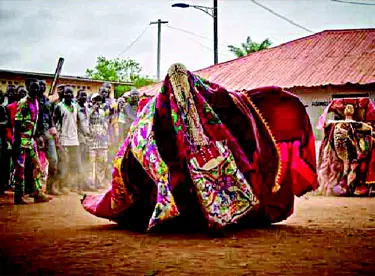
The Egungun Festival is perhaps the most spiritually charged event in the Yoruba calendar. Celebrated across Oyo, Ibadan, Ogbomoso, and countless towns, it honours the Egungun, the ancestral spirits who return to bless, guide, and judge the living. The masquerade dancers, clad in layers of silk, velvet, damask, and cloth embroidered with cowries and beads, become the physical embodiment of the dead. They are not performers playing a role. They are vessels.[](https://www.foluoyefeso.com/post/exploring-the-significance-of-the-egungun-festival-in-yoruba-culture)
For community development, the Egungun Festival is indispensable. An academic study of the festival in Ogbomoso concluded that it has a substantial role in aiding economic growth and stands as one of the last cultural heritages of the Yoruba people. The festival creates employment for drummers, costume makers, praise singers, and food vendors. It attracts visitors from far and near, filling the local economy with festival season revenue.[](https://www.academia.edu/145319120/The_Importance_of_Traditional_Religious_Festivals_among_the_Yoruba_The_Egungun_Festival_in_Ogbomoso)
Yet its deepest contribution is moral. The Egungun are feared and respected because they uphold justice. They remind the community that the ancestors are watching, that ethical conduct matters, and that those who violate social norms will be held accountable. In a world where formal legal systems often fail, the Egungun provide a spiritual judiciary. They preserve iwapele, good character, by making it visible, dramatic, and unforgettable.
Eyo and Sango: Spectacle and Identity
The Eyo Festival, unique to Lagos Island, is often called the ancestor of modern carnival. Its masqueraders, dressed in immaculate white robes and wide-brimmed hats, parade through the streets in honour of departed Obas and elders. No hats are allowed during the festival; it is a sacred space, not a casual outing. The Eyo Festival transforms the urban landscape into a theatre of memory, reminding the cosmopolitan city of its indigenous roots.
The Sango Festival in Oyo is an entirely different energy. Dedicated to the god of thunder and lightning, it features fire rituals, thunderous drumming, and displays of spiritual prowess that attract over twenty thousand attendees from more than forty countries. It is dramatic, electrifying, and unapologetically powerful. The festival reinforces Oyo’s identity as the historical seat of Sango’s empire and creates a global network of devotees who return year after year.
Both festivals demonstrate how tradition can be a brand, a magnet, and a unifying force. They generate tourism revenue, create platforms for local artists, and give young people a reason to engage with their heritage rather than dismiss it as old-fashioned.
Ojude Oba: Faith and Culture Hand in Hand
The Ojude Oba Festival in Ijebu Ode, celebrated on the third day after Eid al-Adha, is a remarkable example of how festivals adapt without losing their soul. The Muslim people of Ijebu gather to pay homage to the Awujale, their traditional ruler, in a festival that blends Islamic faith with Yoruba cultural pageantry. Different age groups, known as regberegbe, parade in matching Aso Oke, competing for the most impressive display of colour, coordination, and pride.[](https://en.wikipedia.org/wiki/List_of_festivals_in_Nigeria)
Ojude Oba proves that community development does not require choosing between tradition and modernity. The festival has become one of the most glamorous events in Ogun State, drawing sponsors, media coverage, and international visitors. It strengthens the regberegbe system, a form of social organisation that provides mutual support, discipline, and collective identity among age mates. When a group of men who were born in the same year march together in identical agbada, they are demonstrating a lifelong bond that transcends individual ambition.
The Development Dividend
If one looks closely at any Yoruba festival, the same developmental benefits appear again and again.
Economic stimulus is immediate and visible. Festivals create markets. Artisans sell textiles, carvings, and ritual objects. Food vendors feed thousands. Transport operators, hotels, and security personnel find seasonal employment. The Egungun Festival alone supports an entire ecosystem of costume makers, drummers, and praise poets.[](https://www.academia.edu/145319120/The_Importance_of_Traditional_Religious_Festivals_among_the_Yoruba_The_Egungun_Festival_in_Ogbomoso)
Social cohesion is less visible but more lasting. Festivals force rival families, political opponents, and estranged neighbours to share space, exchange greetings, and remember that they are kin. The Olojo Festival explicitly calls for politicians to set aside differences. The Osun Festival gathers the global Yoruba family in one grove. These are not trivial niceties. They are conflict prevention mechanisms woven into the cultural calendar.
Cultural education happens organically. Children who watch the Egungun learn their lineage history. Youth who attend the Olojo learn the story of Oduduwa and Ogun. Diaspora visitors who return for the Sango Festival learn that their roots are not abstract; they are living, drumming, and dancing in the streets of Oyo. Festivals are the original schools, and participation is the curriculum.
Identity reinforcement protects against the homogenising pressure of globalisation. In a world where every city has the same fast food chains and streaming platforms, festivals declare that this place, this people, and this history are unique. They give the young a reason to stay, the old a reason to remain relevant, and the diaspora a reason to return.
The Festival as the Future
There is a temptation to view traditional festivals as relics, charming but impractical in a modern economy. The Yoruba experience proves the opposite. The Olojo Festival now has an official Instagram and X handle, engaging the global youth diaspora. The Osun Festival is a UNESCO site. The Sango Festival attracts corporate sponsors. The Egungun Festival has been studied in academic journals for its economic impact. These are not dying traditions. They are evolving institutions.[](https://garlandmag.com/the-olojo-festival/)
The lesson for community development practitioners is clear. Before building a community centre, consider whether the town already has a festival ground. Before designing a cultural programme, ask the elders when the next Egungun will appear. Before importing foreign models of social cohesion, look at how the regberegbe system has kept Ijebu Ode united for centuries.
Traditional festivals are not obstacles to development. They are its oldest, most reliable engine. They run on belief, beauty, and belonging. And unlike so many development projects that wither when funding dries up, festivals endure because they are loved. The Yoruba have known this for a thousand years. The rest of the world is only now beginning to catch up.