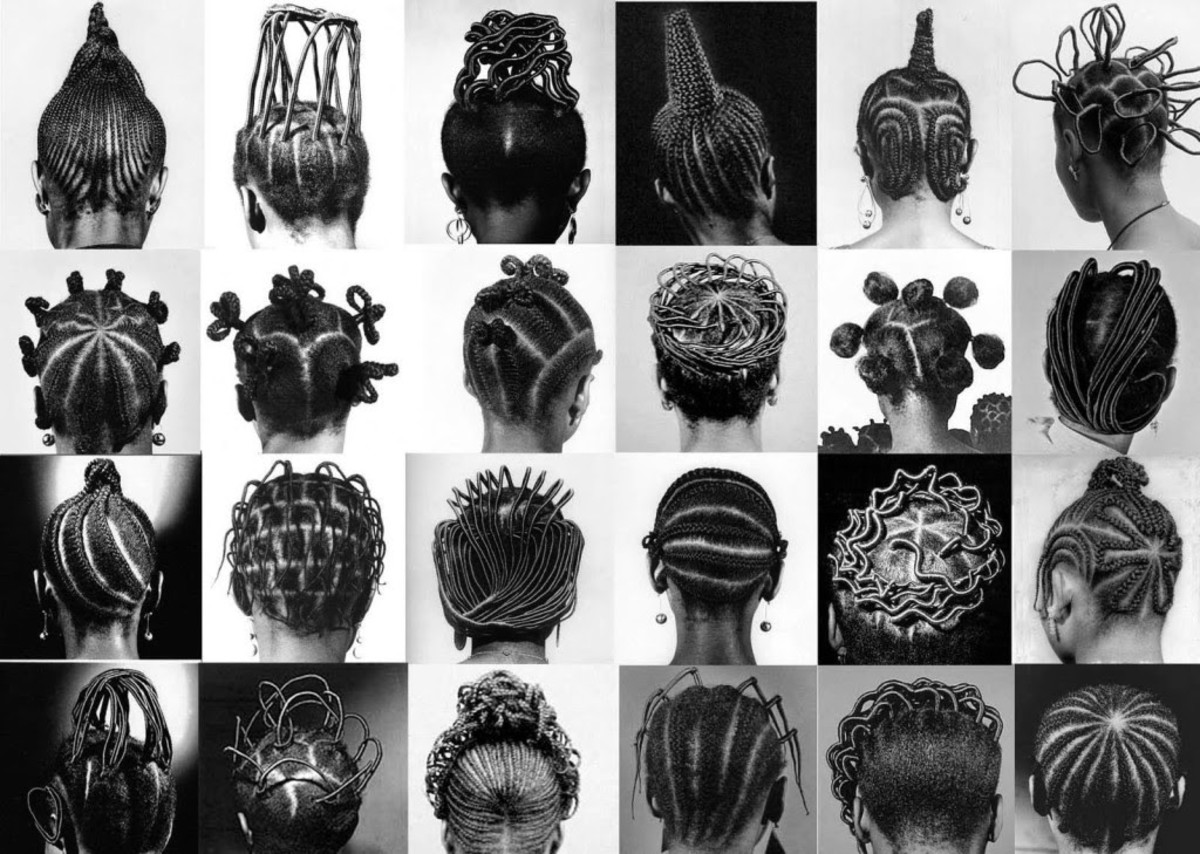
The Hair Is the Beauty of a Woman
There is an old Yoruba saying: Irun ni ewa obinrin. The hair is the beauty of a woman. But to reduce Yoruba hairstyling to mere vanity would miss the point entirely. For centuries, the Yoruba people of southwestern Nigeria, Benin, and Togo have treated the head not simply as a place to grow hair, but as sacred ground. In Yoruba cosmology, the head, or orí, is the seat of destiny, the vessel of the soul, and the most important part of the body. To style the hair, therefore, is to honour oneself, one’s ancestors, and the divine forces that govern fate.
This is not a story about trends. It is a story about identity, spirituality, and survival. From the ancient kingdoms of Ife and Oyo to the bustling streets of modern Lagos, Yoruba hairstyles have served as maps of social status, whispered prayers to the gods, and quiet acts of resistance against colonial erasure. Every braid, thread, and knot carries a meaning. Every style tells you who the wearer is, where she comes from, and what stage of life she has reached.
A Sacred Art: Hair in Yoruba Cosmology
Before the first braid is plaited, the Yoruba hairdresser understands that she is working on holy terrain. The goddess Osun, deity of fresh waters, fertility, love, and beauty, is revered as the first hairdresser and the first to use a comb. According to myth, Osun introduced the art of hairdressing to humanity, and her devotees still invoke her during styling rituals.
Hairdressing in Yorubaland is so deeply respected that a popular adage warns: A kii di irun tabi ge irun leyin olori. One does not plait or cut a person’s hair without the consent of the owner of the head. The hair belongs to the individual in a way that transcends physical possession; it is tied to their orí, their personal destiny. Even the earth itself is personified as a woman whose hair is combed with hoes during farming, praised in verse as Ile, Ogere, a foko yeri. Earth, the goddess, who combs her hair with a hoe.
The Foundation Styles: Threading, Braiding, and Didi
Ìrun Kíkó: The Art of Threading
Ìrun Kíkó, or hair threading, is one of the cornerstones of Yoruba hair culture. Sections of hair are wrapped tightly with black thread, traditionally wool or plastic, from root to tip, creating sculptural shapes that can be straight, spiral, or curved. The style was both decorative and fiercely protective, shielding natural hair from breakage while promoting length retention.
During the colonial and post-colonial era, a variation known as the Police Cap became popular. The threaded sections were swept to one side of the forehead and held down, resembling a beret. Beyond aesthetics, Ìrun Kíkó was a declaration of pride in African hair texture, a refusal to straighten or conceal what nature had given. Today, the style is enjoying a quiet renaissance among natural hair enthusiasts who recognise its protective power and its ability to stretch coily hair without heat.
Didi: The Root of Braiding
The term didi refers to the traditional method of plaiting hair close to the scalp, often using the fingers without additional tools. Didi styles form the foundation of many iconic Yoruba looks, creating neat, raised cornrows that can be manipulated into complex patterns. The technique requires patience and skill, and the resulting styles can last for weeks with proper care. Didi is not merely a technique; it is a language of lines and geometry drawn upon the head.
Hairstyles of Status and Ceremony
Shuku: The Crown of Queens
Perhaps the most iconic of all Yoruba hairstyles, Shuku involves braiding the hair from the edges of the scalp toward the centre of the head, forming a raised, basket-like or circular shape at the crown. The name itself means "round" or "circular," describing the silhouette it creates.
Historically, Shuku was the domain of royalty. Queens and wives of kings wore this style as a mark of regal bearing and elevated status. It was less time-consuming than some elaborate ceremonial styles, making it practical for women of rank who needed to move between palaces and public duties. Variations abound: Suku Onididi, Suku Elegbe, Suku Ologede, and ceremonial versions where braids fall on all sides like a fountain.
Shuku symbolises sophistication, femininity, and readiness for responsibility. It was commonly worn by young women, especially brides-to-be, as part of their wedding preparations and during festive events. In modern times, Shuku has been reimagined by stylists who blend traditional techniques with contemporary aesthetics, yet its essence, the upward sweep of braids crowning the head like a tiara, remains unchanged.
Patewo: Clap Your Hands
Patewo literally translates to "clap your hands." The hair is parted down the middle, and braids from each side are plaited toward the centre, meeting like two palms coming together in prayer or applause. It is a style worn by females of all ages and social statuses, though its spiritual resonance gives it particular importance during religious gatherings.
Patewo can be combined with other styles: Patewo and Curve, Patewo with Base, Patewo and All Back. These hybrid designs speak to the wearer’s creativity. The symmetry of the style is deliberate; it reflects balance, unity, and the Yoruba ideal of iwapele, or good character. When adorned with beads or cowries at the meeting point, it becomes a style fit for celebrations and rites of passage.
Eko Bridge: Architecture in Hair
The Eko Bridge hairstyle is a triumph of imagination. Named after the famous bridge in Lagos, the style divides the hair into approximately ten or eleven sections, which are then threaded and arranged to form an arching structure across the middle of the head, mimicking the actual bridge with its supporting pillars and elevated span.
This style was particularly popular among married women, who wore it as a symbol of connection, stability, and the bridging of two worlds: the domestic and the public, the spiritual and the earthly. The Eko Bridge hairstyle demonstrates something remarkable about Yoruba hairdressing. The head is not just a canvas, but a landscape upon which landmarks, proverbs, and social concepts can be built in three dimensions.
Kojusoko: Face Your Husband
Kojusoko means "face your husband." In this style, the hair is plaited with plastic thread and packed toward the forehead, with the braids bent to frame the face. It was traditionally worn by married women as a gesture of deference and marital commitment. The style paid obeisance to the husband, signalling that the woman’s attention and loyalty were directed toward her home and her spouse.
In a culture where hairstyles function as public announcements of private status, Kojusoko left no ambiguity. It told the community that this woman was spoken for, that she had crossed the threshold from maidenhood into matrimony, and that she embraced the responsibilities that came with it.
Agogo: The Cockscomb and the Priestess
The Agogo hairstyle imitates the proud comb of a cockerel. But its meaning is far more complex than its playful shape suggests. Women who wore Agogo were signalling that they were either married or priestesses belonging to a cult, devotees of Sango, Osun, Esu, Oya, or other orishas.
The style thus functioned as a spiritual badge. It identified women who moved between the secular world and the sacred realm, who carried messages from the gods and administered rituals for the community. To see a woman in Agogo was to know that she possessed spiritual authority, and that her relationship with the divine was woven into the very pattern of her hair.
Hairstyles of Youth and Transition
Ìpàkó Àlèdè: The Pork Head
Ìpàkó Àlèdè translates to "pork head" or "occiput of a pig." In this style, cornrows run from the back of the head straight to the front, creating a sleek, orderly pattern that mirrors the rounded back of a pig’s head. It was typically worn by young girls and unmarried women, signifying youth, vitality, and the bloom of early womanhood.
The style’s neatness and symmetry were seen as reflections of discipline and good character. A young woman who maintained her Ìpàkó Àlèdè impeccably was demonstrating to her community that she possessed the self-control and attention to detail expected of a prospective wife. It was everyday wear, but it was also a performance of respectability.
Kolésè: Celebrating Natural Coils
Kolésè is a cornrow style that runs from the front or top of the head to the back, stopping near the neck. The braids do not continue down the neck; instead, the ends spring upward naturally, celebrating the coily texture of African hair. The name itself echoes the curling motion of the hair’s natural ends.
This style is a powerful statement of natural beauty and heritage. It refuses to tame or alter the hair’s inherent texture, instead allowing the coils to assert themselves as the finishing flourish. In recent years, Kolésè has gained renewed attention on social media, where its resemblance to the signature looks of global artists has sparked conversations about cultural appropriation and the reclamation of African aesthetics.
Korobá: The Upturned Basket
Korobá takes its name from its resemblance to an upturned bucket or basket. Braids radiate from the centre of the head outward to all sides, creating a symmetrical, circular form that is both elegant and practical. The style has long been a symbol of beauty and cultural pride, worn for everyday life as well as festive occasions.
Korobá reflects the Yoruba value of ayewo, balance and visual harmony. The even distribution of braids around the head creates a sense of completeness, of a circle closed and protected. When embellished with beads or cowries, it transforms from a simple daily style into ceremonial attire fit for weddings and naming ceremonies.
The Sacred and the Profane: Spiritual Hairstyles
Dada: Hair as Divine Inheritance
Dada is perhaps the most spiritually charged of all Yoruba hairstyles. It refers to natural, dense hair that is allowed to grow into dreadlocks from a young age, often without combing. In Yoruba belief, Dada hair is associated with the deity Olokun, the powerful orisha of the deep sea, wealth, and mystery. Parents whose children were born with naturally thick, tangled hair believed that cutting it could bring sickness or even death, for the hair was seen as a divine gift, a physical manifestation of spiritual favour.
Children with Dada hair were treated with special reverence. Their hair was oiled, adorned with cowries and beads, and left to grow into locks that marked them as spiritually protected. Even today, Dada remains a potent symbol of African spirituality, a reminder that hair can be a conduit between the human and the divine.
Ilari: The Hair of Palace Messengers
In the royal courts of Oyo and Ife, hairdressing was a political language. The Ilari were male palace messengers whose heads were shaved in distinctive patterns to identify them as servants of the king. At Oyo, male Ilari had alternate sides of their heads shaved every five days, leaving a circular patch on the crown where the hair was allowed to grow long, braided, and dyed with indigo.
Each Ilari carried a name that was itself a message. A messenger named Madarikan, "do not oppose the king," might be dispatched to a recalcitrant subject. His hair proclaimed his office; his name proclaimed his specific errand. Upon a king’s death, the Ilari allowed their hair to grow long in mourning. At the coronation of a new king, their heads were shaved, medicines were rubbed into the incisions, and they received new names, beginning the cycle anew.
At Ife, similar messengers called Emese had their heads shaved on alternate sides every four days. During the festival for Oranmiyan, the legendary warrior born half black and half white, these messengers painted the right half of their bodies red with camwood and the left half white with chalk, their asymmetrical hair decoration echoing the duality of the deity they honoured.
Colonial Erasure and Cultural Resilience
The arrival of European colonial powers brought with it a systematic assault on African cultural practices, and hairdressing was no exception. Missionary schools often forced African girls to cut their hair short, branding traditional styles as uncivilised. The transatlantic slave trade had already inflicted similar violence, with enslaved Africans shaved upon arrival in the Americas to strip them of tribal identity.
Yet Yoruba hairdressing survived as an act of quiet resistance. In the privacy of home compounds, under shaded verandahs and beneath mango trees, mothers continued to thread their daughters' hair. The styles persisted in rural areas even as urban elites began to favour European wigs and straightened hair. By the 1960s and 1970s, the Black Power movement and a growing consciousness of African identity sparked a revival of natural hairstyles across the diaspora. In Nigeria, the Oleku fashion movement and the cultural nationalism that followed independence encouraged young women to reclaim their braids, threads, and cornrows.
The Modern Renaissance: From Lagos to London
Today, Yoruba traditional hairstyles are experiencing a global renaissance. What was once dismissed as village hair is now celebrated on international runways, in music videos, and across social media platforms. Stylists in Lagos, Ibadan, and Abeokuta are fusing ancient techniques with contemporary flair, incorporating coloured threads, gold cuffs, and geometric extensions into classic Shuku and Patewo patterns.
The natural hair movement has played a significant role in this revival. Young Nigerian women, and indeed women of African descent worldwide, are rejecting the chemical relaxers and weave cultures that dominated the 1990s and 2000s. They are returning to the hairstyles of their grandmothers not merely as fashion statements, but as political acts, as ways of saying, this is who I am, and I will not apologise for it.
Photographers like J.D. 'Okhai Ojeikere, who spent decades documenting Nigerian hairstyles in striking black and white portraits, have left archives that inspire contemporary artists and stylists. His work reminds us that these hairstyles are sculptures, three-dimensional art forms that deserve the same reverence accorded to woodcarving, bronze casting, or textile weaving.
The Living Crown
Traditional Yoruba hairstyles are far more than arrangements of fibre upon the scalp. They are archives of memory, maps of social structure, and prayers made visible. From the royal Shuku that crowned queens of old, to the spiritual Dada that connected children to Olokun, to the architectural Eko Bridge that celebrated a modernising Lagos, each style encodes a worldview.
In a global beauty industry that still too often privileges European textures and standards, the persistence of Yoruba hairdressing is a testament to resilience. It is a declaration that beauty is not singular, that the coily, the threaded, and the braided are as worthy of admiration as the straight and the flowing.
To wear a traditional Yoruba hairstyle today is to join a conversation that has lasted for centuries. It is to honour the hands of the hairdresser, the onidiri, who learned her craft from her mother, who learned it from hers. It is to recognise that the hair is not merely an accessory, but a crown. And as the Yoruba have always known, the crown does not sit upon just any head. It sits upon the orí, the sacred seat of destiny itself.