Introduction
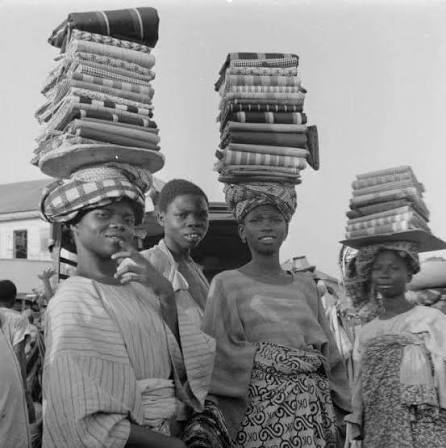
Women were central to the economic life of traditional Yorubaland. Their influence extended far beyond household responsibilities. Women participated actively in farming, food processing, craft production, local and long distance trade, market administration, and the organisation of commercial associations.
In many Yoruba communities, women could accumulate wealth, operate businesses, employ others, control trading networks, and exercise considerable influence within markets. Their economic activities also gave them a voice in community affairs and, in some circumstances, traditional political institutions.
Understanding Yoruba economic history therefore requires recognising women not simply as participants in the household economy, but as important economic actors who helped sustain markets and communities.
Women and the Yoruba Market System
Markets were among the most important spaces where Yoruba women exercised economic influence.
Women traded products such as:
* Food crops. * Palm oil. * Kola nuts. * Vegetables. * Fish. * Cloth. * Pottery. * Household goods. * Prepared foods.
Some women operated small stalls, while others became prosperous merchants who travelled between markets and developed extensive commercial relationships.
The Organisation of Women Traders
Women traders were not simply isolated individuals competing against one another. Markets could have organised groups and leadership structures that helped regulate commercial activities.
Senior market women could help:
* Settle disagreements. * Organise market activities. * Enforce trading customs. * Represent traders before traditional authorities. * Maintain order within the marketplace.
This gave economically successful women a degree of collective influence.
The Ìyálọ́jà
One of the most important traditional female economic offices was the Ìyálọ́jà, literally associated with the leadership of the market.
The institution existed in different forms across Yoruba communities, and its precise responsibilities varied by location and period.
A market leader could be involved in:
* Organising traders. * Maintaining market regulations. * Resolving commercial disputes. * Representing traders. * Communicating with traditional authorities. * Supervising aspects of market administration.
The position demonstrates how economic activity could create recognised forms of female leadership.
Women in Agriculture
Agriculture was another major area of female economic participation.
Women contributed to:
* Crop cultivation. * Weeding and harvesting. * Processing food. * Storage. * Local distribution. * Selling agricultural products.
The division of agricultural labour differed between communities, crops, households, and historical periods, but women's contribution was essential to the food economy.
Food Processing and Preservation
Women were particularly important in transforming agricultural produce into products suitable for consumption and trade.
Activities included processing:
* Cassava. * Palm products. * Yams. * Grains. * Vegetables. * Fruits.
Food processing increased the value and shelf life of agricultural products, allowing families and merchants to transport and sell them over greater distances.
Textile Production and Craft
Women also contributed to Yoruba textile and craft industries.
In particular, women became strongly associated with textile-related activities such as adire production, especially among the Ẹ̀gbá around Abeokuta.
They participated in processes including:
* Dye preparation. * Cloth decoration. * Pattern creation. * Textile finishing. * Marketing.
Adire eventually became one of the best-known expressions of Yoruba textile creativity.
Women and Long-Distance Trade
Some Yoruba women participated in commerce beyond their immediate communities.
They could travel between markets to buy and sell goods, establishing networks based on:
* Family relationships. * Trust. * Credit. * Reputation. * Market knowledge.
This commercial mobility allowed successful traders to accumulate wealth and strengthen their influence within their communities.
Wealth and Social Status
Economic success could translate into social influence.
A prosperous woman might:
* Support relatives. * Sponsor community activities. * Employ assistants. * Contribute to festivals. * Finance trading ventures. * Gain recognition within market organisations.
Women's economic power therefore had consequences beyond individual households.
The Iyalode and Public Influence
Another important institution was the Ìyálóde, a prominent female leadership title found in several Yoruba communities.
The exact authority of the office varied, but an Iyalode could represent women's interests and participate in community affairs.
The existence of institutions such as the Iyalode and Iyaloja demonstrates that women's economic and social influence could extend into public life.
Women's Associations and Collective Power
Collective organisation strengthened women's economic position.
Women could form groups around:
* Trading. * Food production. * Craft industries. * Market activities. * Community welfare.
Such associations allowed women to pool knowledge, support members, regulate activities, and speak collectively when dealing with traditional authorities.
Women and the Household Economy
Women's economic contributions also supported the household.
Income generated through farming, processing, crafts, and trade could help provide:
* Food. * Clothing. * Children's education or training. * Household necessities. * Capital for future trading.
In this sense, women's economic activity helped maintain both individual families and the wider community.
Economic Influence and Political Power
Economic influence could sometimes translate into political influence.
Successful female traders and market leaders could become respected community figures whose opinions mattered to traditional authorities. In some Yoruba political systems, female title holders had recognised roles in governance and could advocate for the interests of women.
However, women's authority was not identical across all Yoruba kingdoms. Yoruba society was diverse, and the political influence available to women depended on local institutions, status, wealth, lineage, and historical period.
Women as Economic Innovators
Yoruba women's economic influence was not limited to participating in existing systems. Women also developed their own commercial strategies.
They:
* Identified profitable goods. * Built customer networks. * Negotiated prices. * Managed supply chains. * Passed business knowledge to younger generations. * Adapted production to market demand.
This entrepreneurial tradition has remained visible in Yoruba commercial culture into the modern era.
The Legacy of Yoruba Women's Economic Power
The economic traditions established by generations of Yoruba women continue to influence contemporary society.
Modern Yoruba women remain prominent in:
* Retail. * Manufacturing. * Fashion. * Food businesses. * Textile production. * Agriculture. * Professional services. * Entrepreneurship.
Traditional market institutions and craft traditions have also adapted to modern economic conditions.
Conclusion
Women were indispensable to the economic development of traditional Yorubaland. Through farming, food processing, textile production, craftwork, and especially commerce, they helped move goods through markets and connected households to wider regional economies.
Institutions such as the Ìyálọ́jà and Ìyálóde demonstrate that economic influence could develop into recognised forms of social and political authority. Although women's experiences and opportunities differed between Yoruba communities and historical periods, their contribution to commerce and community life was consistently significant.
The story of Yoruba economic history is therefore incomplete without the women who cultivated its fields, produced its goods, organised its markets, built trading networks, accumulated wealth, and passed entrepreneurial knowledge from one generation to the next.