Introduction
There is a profound Yoruba saying: Adiye irana ki soun ajegbe. One must repay eating the sacrificial funeral fowl. It is a gentle reminder that every soul must taste death, and that the living carry a debt to the dead. For the Yoruba people of southwestern Nigeria, death is not a full stop. It is a comma, a pause, a transition from one room of existence to another. The physical world, called Aiye, and the spirit world, called Orun, are not separate countries. They are dance partners, constantly moving in sync, and death is merely the step that carries the soul from one partner to the other.[](https://www.talkdeath.com/the-traditional-death-rites-of-the-yoruba/)
This worldview shapes everything about how the Yoruba approach death. A funeral is not simply a farewell. It is a carefully choreographed passage, a social event, a spiritual obligation, and often a vibrant celebration. The way a person is buried says as much about the living as it does about the departed. It reveals the family’s resources, their respect for tradition, their religious convictions, and their desire to ensure that their loved one arrives safely in the ancestral realm.
The Geography of the Afterlife
To understand Yoruba funeral traditions, one must first understand their map of existence. The Yoruba cosmos is divided into two interconnected realms: Aiye, the visible world of the living, and Orun, the invisible world of the spirits, ancestors, and divine forces. These realms are not distant. They are layered, overlapping, and in constant communication. The dead do not vanish. They become Egungun, ancestral spirits who remain present, accessible, and deeply involved in the affairs of the living.[](https://oriire.com/article/journeying-beyond-unraveling-the-yoruba-belief-of-the-afterlife)
When a person dies, their soul embarks on a journey to Orun, where it faces a tribunal of ancestors. These wise judges evaluate the life that has been lived, weighing actions, intentions, and impact upon others. Based on this judgement, the soul may return to earth through reincarnation, or it may assume the role of an ancestral spirit, guiding and protecting descendants. A child born shortly after an elder’s death is often seen as that elder returned. Boys are named Babatunde, father has come back. Girls are called Iyabo or Yetunde, mother has returned.[](https://oriire.com/article/journeying-beyond-unraveling-the-yoruba-belief-of-the-afterlife)
This belief in continuity makes death less frightening and more familiar. It is the ultimate family reunion, a homecoming that never ends. But there is a catch. The journey home depends entirely on how well the living perform the proper send off rituals. One misstep, and the soul may become an aku da aya, a wandering spirit stuck in an endless airport layover between worlds.[](https://oriire.com/article/yoruba-isinku-practices-and-taboos)
The Spectrum of Death: Good Death and Bad Death
Not all deaths are treated equally in Yoruba culture. There is a clear distinction between Iku Rere, a good death, and Iku Buruku, a bad death, and every family hopes for the former.
Iku Rere: The Homecoming
A good death belongs to the elderly. It is the passing of someone who has lived fully, fulfilled their destiny, left behind children and grandchildren, and died of natural causes. This is not a tragedy. It is a graduation. The Yoruba say Iku to da bi orun lo, a death that is like a journey to heaven. The funeral becomes an Ayeye, a celebration of life marked by dancing, music, drumming, and lavish feasting. The community gathers not to mourn but to honour a life well lived and to welcome a new ancestor who will intercede on their behalf in the spirit world.[](https://www.celebratethem.com/blog/yoruba-funeral-traditions-explained)
Iku Buruku: The Sorrowful Departure
A bad death, or Okú Ofò, is an entirely different affair. It claims the young, the unfulfilled, those who die by accident, suicide, witchcraft, or murder. These deaths are considered untimely because the individual has not completed their earthly destiny. Their spirit may wander, restless and unable to reach Orun. Funerals for Okú Ofò are brief, sombre, and stripped of celebration. There is no music, no dancing, no feasting. Before any public announcement, priests and diviners perform Iwadi fini fini, a spiritual autopsy to determine the exact cause of death. The corpse may be taken into a secret enchanted room, and its spirit invoked to tell its own story.[](https://oriire.com/article/yoruba-isinku-practices-and-taboos)
In cases of murder, a highly secretive rite called Riro Oku is performed. This allows the spirit of the dead to linger in the earthly realm for about seven days, hunting down everyone involved in their death. It is a terrifying prospect for the guilty and a powerful form of spiritual justice for the victim. Parents are forbidden from burying a child who died untimely, not out of cruelty, but for protection. The wandering spirit might cling to them, causing further calamity or even Abiku, the cycle of repeated infant deaths.[](https://oriire.com/article/yoruba-isinku-practices-and-taboos)
The Stages of Isinku: The Burial Rites
The Yoruba funeral process, known as Isinku, is a multi day event that blends solemn ritual with communal support. While modern Christian and Muslim families may adapt certain elements, the underlying structure remains remarkably consistent.
Itufu: The Announcement
When death occurs, the family does not rush to the marketplace with the news. There is a hierarchy of grief. The eldest surviving sibling or the family head, the Baale, is informed first. The method of announcement depends on the status of the deceased. If a king dies, euphemisms are used. No one says the king is dead. Instead, they say Oba waaja, he has gone up the ceiling. Or Erin wo, the elephant has fallen. Or Opo ye, the pillar has given way. These beautiful phrases protect the divine mystique of the throne and shield the community from the shock of loss. For ordinary people, the family head makes the announcement, sometimes accompanied by ceremonial gunfire. The corpse is covered in white cloth, and the surroundings are prepared so that mourners meet the dead in a decent state.[](https://oriire.com/article/yoruba-isinku-practices-and-taboos)
Itoju Oku: Caring for the Body
The purification of the corpse is perhaps the most important spa treatment ever conceived. The body is washed thoroughly, because arriving dirty in the spirit world could mean denial of entry. Any remaining dirt might even appear as birthmarks when the soul reincarnates. The process is beautifully gendered. Women wash and braid the hair of female corpses, while men handle male corpses. After washing, the body is anointed with white camwood that turns red, and the hands and feet are positioned with care. The deceased is dressed in fine white attire, the colour of purity and spiritual passage. The firstborn son has the honour of pouring water on his father’s corpse, a final act of filial care.[](https://oriire.com/article/yoruba-isinku-practices-and-taboos)
Tite Oku: Lying in State
After purification, the deceased is laid out on a raised surface, honoured like the most important guest at their own farewell. This is Tite Oku ni Ite Eye, the lying in state, and it can last for two or three days. Women of the household praise the deceased, chanting their Oriki, the lineage poetry that celebrates their ancestry, character, and achievements. The body is dressed in finest attire, men in agbada and fila, women in iro, buba, and gele. The body openings, mouth, nose, and ears, are traditionally blocked with thread, though cotton wool is used today. Perfumes are applied, and the space is decorated so that the dead rest in dignity.[](https://yorubalessons.com/2022/02/24/burial-and-funerals-in-the-yoruba-culture-isinku/)
The Burial Itself
Traditionally, Yoruba people were buried within the family compound, sometimes beneath the floor of the house they once occupied. This practice ensured that the dead remained close to their people, literally under the same roof. In modern cities like Lagos, Ibadan, and Abeokuta, public cemeteries have become standard, though some families still bury their dead on personal property, particularly in hometowns.[](https://www.celebratethem.com/blog/yoruba-funeral-traditions-explained)
The coffin is prepared with extraordinary care. Inside, the deceased is given provisions for the journey: cold pap, wine, kola nuts, clothes, shoes, walking sticks, beads, hoes, swords, knives, and money. The Yoruba afterlife is not an abstract, disembodied existence. It is a continuation of life where one will need favourite things and want to maintain status. Your earthly success transfers with you. The firstborn pours the first soil onto the coffin, and family members throw sand or flowers into the grave, bidding farewell and asking the deceased to greet other loved ones in heaven.[](https://yorubalessons.com/2022/02/24/burial-and-funerals-in-the-yoruba-culture-isinku/)
Adiye Irana: The Sacrificial Fowl
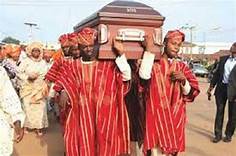
As the corpse is carried to the burial site, a mourner walks ahead, pulling out black feathers from a sacrificial fowl and scattering them along the road. This fowl, the Adiye Irana, is slaughtered at the graveside after burial, and its blood is poured into the grave. The significance is layered. The sacrifice wards off evil spirits that could hinder the soul’s transition. It symbolises the inevitability of death, the debt that every living person must one day repay. Those who carried the corpse eat the fowl by the graveside, acknowledging that one day, their own funeral fowl will be eaten by others. It is a communal contract with mortality, a shared meal that binds the living to the dead.[](https://www.talkdeath.com/the-traditional-death-rites-of-the-yoruba/)
The Reception: Where Grief Becomes Celebration
After the burial, the reception begins, and this is where Yoruba funeral traditions truly come alive. For an elder who died a good death, the reception is an Owambe, a large, lavish party with food, music, dancing, and socialising. Live bands, often playing juju, fuji, or gospel, perform throughout the event. Enormous quantities of food are served: jollof rice, pounded yam and egusi, amala and ewedu, assorted meats, and small chops.[](https://www.celebratethem.com/blog/yoruba-funeral-traditions-explained)
Guests wear Aso Ebi, matching fabrics that create a sea of coordinated colour. The Aso Ebi is central to the visual culture of Yoruba funerals. It signals solidarity, collective grief, and communal identity. Guests spray money on musicians and on each other while dancing, a tradition that signifies celebration, generosity, and appreciation. Families give out customised souvenirs bearing the deceased’s name and photograph. The reception can last for hours and is often the part of the funeral that people remember for months afterwards. It is not unusual for a Yoruba funeral reception to outshine many weddings in scale and splendour.[](https://www.celebratethem.com/blog/yoruba-funeral-traditions-explained)
Egungun: The Living Dead
No discussion of Yoruba death beliefs is complete without the Egungun, the masked ancestral spirits who physically manifest among the living. The Egungun are not merely remembered. They are invited. During annual festivals, masquerade dancers don elaborate costumes that completely conceal their bodies, becoming the visible embodiment of departed ancestors. They dance through the community, bringing blessings, purification, and a sense of continuity between the living and the dead.[](https://www.mdpi.com/2313-5778/3/1/7)
The Egungun festival is a joyous occasion that fosters community cohesion, strengthens family bonds, and celebrates the eternal connection with those who have gone before. The masquerades visit the palace, the gravesides of former chiefs, and the homes of their descendants. They utter prayers, accept sacrifices, and remind the community that the dead are not gone. They are simply wearing different clothes. In Oyo, the Mowuru masquerade, the personal Egungun of the Alaafin, performs intricate rituals of invocation at the graves of former chiefs, inviting the long dead to converge for worship and communion with the people
Taboos and Sacred Boundaries
Yoruba burial customs are governed by Eewo, taboos that are not mere superstitions but cosmic laws with spiritual enforcement. Breaking them can invite supernatural penalties from the gods and ancestors.
Where You Are Buried Matters
People who committed serious offences, witches, murderers, and those who violated sacred customs, are buried in the bush or the evil forest, far from the family compound. This is both punishment and spiritual quarantine, preventing their negative energy from contaminating the community. Cremation is reserved for criminals, the possessed, and war victims. It is the ultimate reset button, used when someone’s spiritual energy is too dangerous to let naturally decompose into the earth.[](https://oriire.com/article/yoruba-isinku-practices-and-taboos)
Royal Mysteries
Kings live and die by different rules. It is forbidden to announce a king’s death directly. It is forbidden for a king to see a dead body or eat in public. These taboos maintain the divine mystique essential for the kingdom’s wellbeing. When a king dies, the chief cabinet manages the transition in secret, ensuring that the spiritual centre of the community remains stable even as the physical ruler changes.[](https://oriire.com/article/yoruba-isinku-practices-and-taboos)
Widowhood Rites
When a woman becomes a widow, she mourns indoors for anywhere between forty days and three months. She does not wear bright clothing or jewellery. She shaves her head and withdraws from social life. A widower, by contrast, is not expected to sleep alone. Another woman sleeps beside him so that the dead wife will not come and lie by his side. These customs reflect the belief that the dead remain close, and that the living must negotiate space carefully with spirits who have not yet fully departed.[](https://yorubalessons.com/2022/02/24/burial-and-funerals-in-the-yoruba-culture-isinku/)
The Modern Evolution: Faith and Tradition
The arrival of Christianity and Islam has profoundly reshaped Yoruba funeral practices. Missionary schools once condemned traditional rites as pagan. Modern Christian families now hold services of songs in churches, with structured liturgies, hymns, and tributes. Muslim families perform the Janazah, the funeral prayer, and bury their dead within twenty four hours, following Islamic law. Cremation, once unthinkable, is slowly gaining acceptance among urban youth for practical reasons.[](https://www.celebratethem.com/blog/yoruba-funeral-traditions-explained)
Yet the old ways persist, often blending seamlessly with the new. A Christian Yoruba family may hold a church service on Saturday morning, bury their dead by afternoon, and host a traditional reception with talking drums and Aso Ebi by evening. Muslim families may perform the Janazah promptly, then gather days later for a cultural celebration that includes traditional praise singers and ancestral invocations. The Yoruba have never seen tradition and faith as enemies. They are simply different dialects of the same spiritual language.[](https://www.celebratethem.com/blog/yoruba-funeral-traditions-explained)
Conclusion:
The Yoruba approach to death offers something rare in a world that often treats mortality as the ultimate taboo. They have created a system where death becomes not something to fear, but something to prepare for thoughtfully, celebrate appropriately, and honour correctly. Every action ripples through spiritual dimensions. Every funeral is a quality control check on the soul’s journey home. The living and the dead remain forever intertwined.
Whether one is drawn to their emphasis on family continuity, their belief in the soul’s eternal journey, or their system of spiritual accountability, the Yoruba burial traditions reveal how human societies create meaning around life’s final transition. In the end, these customs are not just about death. They are about how to live with such respect for the spiritual order that even your final act becomes a gift to the generations who will one day perform the same rites for you.