Introduction
When people think about Yoruba music, the dùndún, popularly known as the talking drum, is often the first instrument that comes to mind. Its ability to imitate aspects of Yoruba speech has made it one of the most famous African musical instruments in the world.
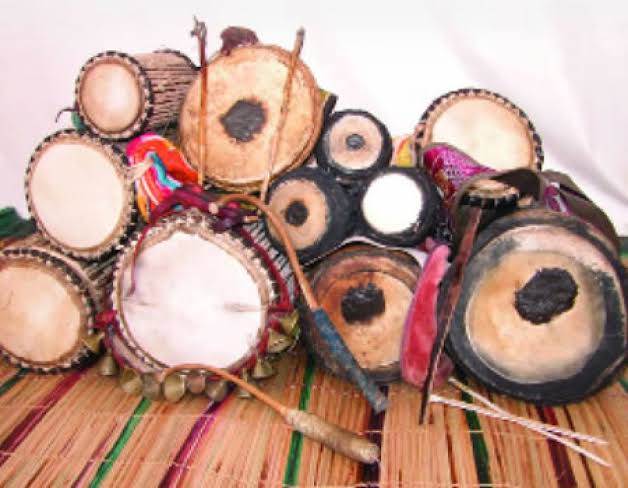
However, Yoruba musical culture is far richer and more diverse than the talking drum alone. For centuries, Yoruba communities have developed and used a remarkable variety of instruments for ceremonies, entertainment, worship, communication and storytelling.
1. Bàtá Drums
The Bàtá is one of the most important drum traditions in Yorubaland.
Bàtá drums are commonly associated with Ṣàngó, the Yoruba Òrìṣà connected with thunder and powerful authority. The ensemble consists of drums of different sizes and functions, creating complex rhythms and musical conversations.
Bàtá music is not simply about producing sound. Skilled performers communicate meaning through rhythm, movement and performance.
Today, the influence of Bàtá can also be found far beyond Nigeria, particularly in Afro Cuban musical and religious traditions.
2. Gángan and the Dùndún Family
The famous talking drum is actually part of a wider family of Yoruba drums.
The gángan is among the best known members of this family. By squeezing the cords connecting its drumheads, a skilled drummer can change the pitch and imitate patterns of Yoruba speech.
Other instruments within Yoruba drum ensembles may perform supporting rhythmic roles.
This is one reason Yoruba drumming is so sophisticated: it often involves an entire musical community rather than one instrument performing alone.
3. Ṣẹ̀kẹ̀rẹ̀
The ṣẹ̀kẹ̀rẹ̀ is a percussion instrument made from a dried gourd covered with a net containing beads or other small objects.
When shaken, struck or moved rhythmically, it produces distinctive sounds that can support singers and drummers.
The ṣẹ̀kẹ̀rẹ̀ is an excellent example of indigenous creativity because a natural material is transformed into a sophisticated musical instrument.
It remains popular in traditional and contemporary African music.
4. Agídìgbò
The agídìgbò is a traditional Yoruba lamellophone, sometimes described as a thumb piano.
It produces sound through vibrating metal tongues attached to a resonating body.
The instrument can create rhythmic and melodic patterns and has traditionally been used in forms of Yoruba musical performance.
Its sound is very different from the powerful drums often associated with Yoruba music, showing the variety within the tradition.
5. Fìlà or Traditional Flutes
Wind instruments have also existed within Yoruba musical traditions.
Traditional flutes could be made from natural materials and used to produce melodies in social and ceremonial settings.
Unlike drums, which often dominate public performances, flutes provide a softer musical voice and demonstrate another side of Yoruba musical creativity.
6. Agogo and Metal Bells
Metal bells, often referred to as agogo, provide important rhythmic patterns.
A bell may create a repeated timeline that helps guide other musicians.
This means that even a seemingly simple instrument can play an essential role in keeping an entire musical ensemble together.
The sound of metal instruments also adds another layer to the rich texture of Yoruba music.
7. Àwọ̀rà and Other Percussion Instruments
Yoruba musical traditions include many forms of percussion beyond the famous talking drum.
Musicians have traditionally used:
* Wooden instruments. * Metal instruments. * Gourds. * Bells. * Rattles. * Hand percussion.
The materials available in the environment often influenced how instruments were made.
This demonstrates how music, craftsmanship and nature were closely connected.
8. Music and Religion
Many Yoruba instruments have important ceremonial and religious roles.
Different musical traditions may be associated with particular communities, occasions or Òrìṣà traditions.
Music can accompany:
* Festivals. * Ceremonies. * Praise performances. * Religious observances. * Royal occasions.
In these contexts, instruments are not simply entertainment. They become part of communication, identity and cultural expression.
9. Musical Instruments as Communication
One of the most remarkable aspects of Yoruba music is its connection with language.
Because Yoruba is a tonal language, changes in pitch can influence meaning.
This allows certain instruments, especially pitch changing drums, to imitate aspects of spoken language.
A skilled performer may use music to communicate:
* Praise names. * Proverbs. * Announcements. * Historical references.
Music can therefore become another form of speech.
10. The Role of Musicians in Yoruba Society
Traditional musicians were often important members of their communities.
They could preserve:
* History. * Praise poetry. * Family traditions. * Royal memory. * Religious knowledge.
A musician was sometimes more than an entertainer.
Through performance, they could become a guardian of cultural memory.
11. Yoruba Instruments in Modern Music
Traditional Yoruba instruments continue to influence modern Nigerian music.
Their rhythms can be heard in styles connected with:
* Jùjú. * Fújì. * Apàlà. * Sakara. * Modern Afrobeats.
Contemporary musicians and producers continue to draw inspiration from traditional percussion and Yoruba rhythmic patterns.
This demonstrates that indigenous instruments are not disappearing. They are adapting.
Conclusion
The talking drum may be the most internationally recognised Yoruba instrument, but it represents only one part of a much larger musical world.
From the powerful rhythms of Bàtá to the distinctive sounds of the ṣẹ̀kẹ̀rẹ̀, agídìgbò and agogo, Yoruba musical instruments demonstrate centuries of creativity and technical knowledge.
Each instrument carries its own sound, history and cultural purpose.
Together, they remind us that Yoruba music is not built around a single drum.
It is an entire orchestra of history, language, rhythm and identity.
To understand Yoruba music fully, we must listen beyond the talking drum.