Introduction
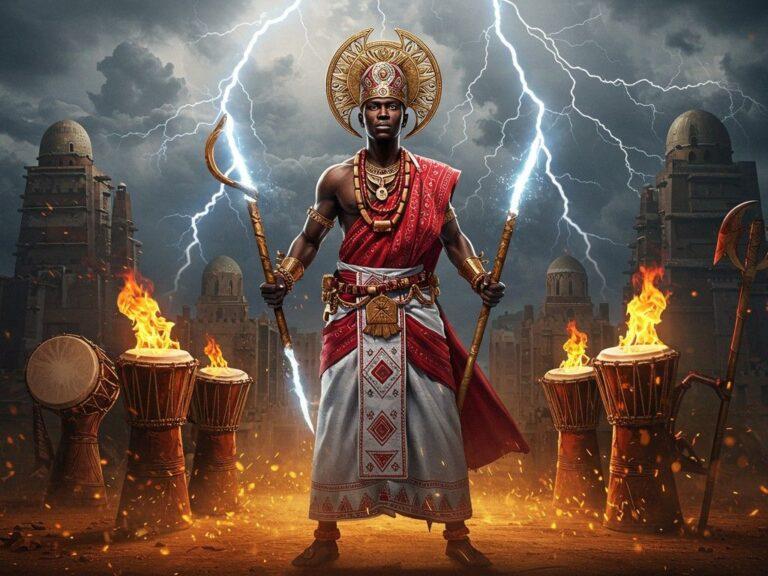
Among all the figures in Yoruba history and spirituality, few are as famous as Ṣàngó. Today, he is revered throughout Yorubaland and across the Yoruba diaspora as the Òrìṣà of thunder, lightning, justice, power, and kingship. Yet Ṣàngó was not originally worshipped as a deity.
According to Yoruba historical traditions and oral accounts, Ṣàngó was once a human king, a powerful ruler of the ancient Oyo Kingdom who later became one of the most prominent deified figures in Yoruba religion.
His story stands at the intersection of history, legend, politics, and spirituality, making him one of the most fascinating personalities in Yoruba civilisation.
Ṣàngó the Historical King
Historical traditions identify Ṣàngó as one of the early Alaafins (kings) of the ancient Oyo Empire.
Although exact dates remain debated among historians, many traditions place his reign several centuries before the colonial era, during the formative years of Oyo's rise as a major Yoruba power.
Ṣàngó was remembered as:
* A courageous warrior * A skilled military leader * A charismatic ruler * A man of immense personal authority * A king whose presence inspired both admiration and fear
The Oyo Kingdom was expanding during this period, and strong leadership was essential for maintaining authority over territories and rival groups.
Stories about Ṣàngó consistently emphasise his extraordinary energy and commanding personality.
The King Associated with Fire and Thunder
One of the most enduring aspects of Ṣàngó's legend is his association with fire.
According to oral traditions, Ṣàngó possessed powerful mystical knowledge that allowed him to command destructive forces.
Some stories describe him as having access to charms that could produce fire.
Others portray him as possessing supernatural powers connected to lightning and thunder.
Whether these accounts are understood literally, symbolically, or as legendary embellishments, they reflect how deeply impressed people were by his power.
Over time, these stories contributed to the belief that thunder and lightning became manifestations of Ṣàngó's spiritual presence.
The Conflict That Changed Everything
The most famous account of Ṣàngó's transformation concerns the tragic events that followed a period of political turmoil.
Several traditions recount that Ṣàngó's temper and immense power eventually contributed to difficulties within his kingdom.
One popular narrative tells of an incident involving magical powers that produced devastating consequences, causing destruction among his own people.
As criticism mounted and opposition grew, Ṣàngó reportedly lost support from important chiefs and subjects.
Faced with political crisis and personal despair, he left the capital.
The details vary among traditions, but many accounts state that he journeyed to a place called Koso.
There, according to legend, he disappeared from the world of human beings.
"The King Did Not Hang"
After Ṣàngó's disappearance, rumours spread that he had died.
However, loyal followers rejected this interpretation.
According to Yoruba oral tradition, his devoted supporters declared:
> "Oba kò so."
Meaning:
> "The king did not hang."
Over time, this phrase evolved into Kòso, which became one of Ṣàngó's important praise names.
His followers insisted that he had not suffered an ordinary human death.
Instead, they maintained that he had ascended into the spiritual realm and become an immortal force.
This belief marked the beginning of his transformation from historical ruler to divine figure.
The Birth of the Òrìṣà Ṣàngó
Following his departure, reports of unusual thunderstorms, lightning strikes, and extraordinary natural events were interpreted as signs of Ṣàngó's continuing presence.
Gradually, people began to view him not merely as a former king but as a powerful spiritual being.
His cult expanded.
Shrines were established.
Priests and devotees emerged.
Songs, praise poetry, and rituals developed around his memory.
The historical king became the Òrìṣà Ṣàngó.
This process of deification was not unique in African history. Across many cultures, exceptional rulers, heroes, and ancestors sometimes became objects of reverence after death.
In Yoruba tradition, however, Ṣàngó became one of the most influential examples of this phenomenon.
Ṣàngó as the Òrìṣà of Justice
As his worship evolved, Ṣàngó came to represent much more than thunder.
He became associated with:
* Justice * Leadership * Courage * Authority * Truthfulness * Accountability
Thunder and lightning symbolised swift judgement.
Because lightning strikes without warning, many devotees viewed Ṣàngó as a force that exposes wrongdoing and punishes falsehood.
This association with justice remains one of the defining aspects of his worship today.
The Symbolism of the Double Headed Axe
One of Ṣàngó's most recognisable symbols is the double headed axe, known as Ọ̀ṣẹ̀ Ṣàngó.
The axe represents:
* Power balanced by responsibility * Authority tempered by wisdom * The ability to act decisively * The dual nature of creation and destruction
It serves as a reminder that leadership requires more than strength alone.
A ruler must also exercise restraint and fairness.
Ṣàngó in the Yoruba Diaspora
The transatlantic slave trade carried Yoruba religious traditions throughout the Americas.
As a result, Ṣàngó remains widely revered in:
* Nigeria * Benin * Togo * Cuba * Brazil * Trinidad and Tobago * The United States * Various parts of Europe
In Cuba's Lucumí tradition, he is known as Changó.
In Brazil's Candomblé, he continues to be honoured as a powerful Òrìṣà associated with justice, thunder, and kingship.
His worship has survived centuries of displacement and cultural change.
Historical Reality and Sacred Tradition
It is important to recognise that Ṣàngó exists simultaneously in two realms of understanding.
From a historical perspective, he was likely a real Alaafin of Oyo whose leadership left a lasting impression on Yoruba society.
From a spiritual perspective, he is an Òrìṣà whose power extends far beyond his earthly life.
For many Yoruba people, these two perspectives do not contradict one another.
Rather, they complement each other.
The historical king became the spiritual force.
The human ruler became an immortal symbol.
Lessons from the Story of Ṣàngó
The story of Ṣàngó offers several enduring lessons:
* Great power requires responsibility. * Leadership must be balanced with wisdom. * Actions have consequences. * Courage must be tempered by self control. * True influence can outlive physical death.
His story also illustrates how memory, culture, and spirituality interact to preserve the legacy of remarkable individuals.
Conclusion
Ṣàngó's journey from king to Òrìṣà is one of the most remarkable narratives in Yoruba history and spirituality. What began as the life of a powerful ruler evolved into a sacred tradition that has endured for centuries.
Whether viewed through the lens of history, mythology, or religion, Ṣàngó remains a symbol of strength, justice, authority, and transformation. His story demonstrates how extraordinary leaders can transcend their own lifetimes and become enduring forces in the cultural and spiritual consciousness of a people.
Today, whenever thunder rolls across the sky, many devotees still remember Ṣàngó, the king who became an Òrìṣà, and whose legacy continues to echo throughout Yorubaland and the wider world.