When the World Began to Die
In the time before memory, when the Orishas still walked the earth as freely as the wind moves through grass, Olodumare sent seventeen of them down to build creation. They came with great purpose — Obatala to shape human form, Ogun to clear the forest, Shango to rule the skies. They arrived with power, authority, and the full blessing of the Most High.
But they made one terrible mistake. They left behind Oshun.
She was the youngest. The most beautiful, they agreed — but beauty, they reasoned, was not practical. What would beauty do among the hard work of building a world? And so Oshun was not invited.
The seventeen Orishas descended and began their work. But strange things started happening. Rain came but found no rivers to flow into. Seeds fell but found no soil that wanted them. Children were born but could not laugh. The earth was being built, yes — but it was being built wrong, like a house with beautiful walls and no door.
The Cry of the Earth
The rivers dried. The animals grew thin. Even Ogun's iron began to rust before he could use it. The Orishas worked harder — consulting, debating, constructing — but nothing took hold. The world seemed to refuse them.
Finally, humbled and exhausted, they returned to Olodumare. "The work will not hold," they said. "We do not know why."
Olodumare looked at them for a long time. "Count yourselves," he said at last.
Seventeen. There should have been eighteen.
The shame was immediate. They had left out Oshun. And without her, nothing they built could live.
What Oshun Did
They found her beside a pool of still water, her copper bracelets catching the last light. She did not rage. She did not demand an apology — though she had earned one. She simply said, "Show me what you have built."
They took her through the dry rivers and the dead soil and the silent villages. She walked slowly, touching things — a cracked rock, a withered leaf, a child sleeping with no dream. And as she walked, she began to hum.
The sound was small at first. Barely audible. But wherever Oshun's bare feet touched the earth, something stirred. A trickle of water appeared. A bird lifted its head. A child in a nearby hut opened its eyes and smiled for no reason.
By the time Oshun had walked the length of the land, the great Osun River was running full and clear. The forests were rustling. The rivers were finding their banks again. The world had accepted its purpose.
What the River Remembers
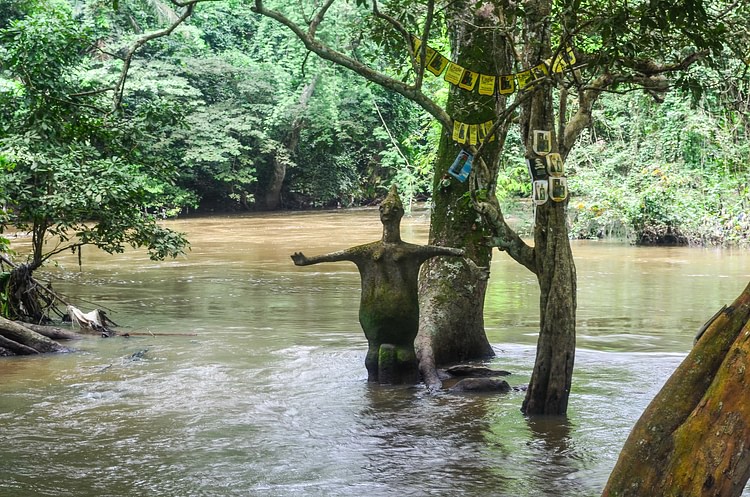
Every year in Osogbo, the people gather at the sacred grove of Oshun. They carry calabashes of honey — for Oshun loves sweetness above all things. They tie yellow fabric to the trees. They sing and dance and ask her to keep the waters flowing.
Scientists call it a river. Yoruba people know it is something more — it is the proof that love is not a luxury. It is the very thing that makes life work.
And if you stand by the Osun River at dawn when the mist is still on the water and the first birds are calling, the elders say you can still hear Oshun humming — quietly, contentedly — as if she is still walking the earth and making it beautiful.
Moral: The most overlooked among us often carries the greatest gift. No community is whole when it dismisses any of its members.
Moral of the story
The most overlooked among us often carries the greatest gift.