Introduction
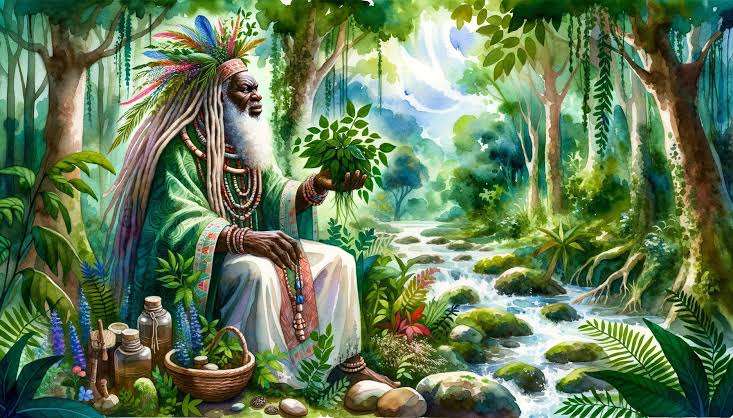
In Yoruba spiritual tradition, Erinlẹ̀ is remembered as one of the most mysterious and balanced Òrìṣà, embodying both the wildness of the forest and the gentleness of healing. He is often described as a divine hunter, healer, and guardian of the natural world, a figure who bridges survival and restoration.
Unlike Òrìṣà who represent only war, wisdom, or fertility, Erinlẹ̀ carries a dual responsibility. He takes life from the forest through hunting, yet also preserves life through healing herbs and deep knowledge of nature. His story reflects a profound Yoruba understanding of balance, where destruction and healing are not opposites but parts of the same cycle.
Who Is Erinlẹ̀?
Erinlẹ̀ is associated with:
* Forests and wild nature * Hunting and survival * Herbal medicine and healing * Rivers and natural springs * Balance between taking life and restoring life
In some traditions, Erinlẹ̀ is also linked with the earth’s hidden medicinal wisdom, especially plants found deep within forests.
He is often described as a guide for hunters, herbalists, and those who seek knowledge of nature’s secrets.
The Hunter Who Understood the Forest
According to Yoruba oral traditions, Erinlẹ̀ was once a great hunter who knew the forest more intimately than anyone else.
He did not see the forest merely as a place of survival. He saw it as a living intelligence.
While others entered the forest only to take, Erinlẹ̀ entered to understand.
He learned:
* The movements of animals * The behaviour of plants * The timing of seasons * The hidden language of nature
Because of this deep connection, the forest responded to him differently. It did not only provide him with game. It also revealed its healing powers.
The Discovery of Healing Wisdom
One of the most important teachings in Erinlẹ̀’s story is that knowledge of hunting naturally leads to knowledge of healing.
As he spent years in the forest, Erinlẹ̀ began to notice something important:
Every animal he hunted, every wound inflicted, and every hardship faced in the wild had a counterpart in the plants around him.
He discovered that:
* Some plants could heal wounds * Some roots restored strength * Some leaves reduced pain and fever * Some herbs purified the body
Over time, he became not only a hunter but also a healer.
This transformation reflects a key Yoruba principle:
> Whatever has the power to harm also contains the knowledge to heal.
Erinlẹ̀ and the River of Renewal
In many traditions, Erinlẹ̀ is also associated with a sacred river spirit, often referred to as Erinlẹ̀ River.
The river symbolises:
* Renewal after hardship * Cleansing and purification * Flow of life and balance * Connection between land and spirit
Just as the forest represents survival and challenge, the river represents healing and restoration.
Together, they define Erinlẹ̀’s identity as a force of balance.
He is both the one who enters danger and the one who brings peace after it.
The Journey Between Two Worlds
Erinlẹ̀ is often described as existing between two realms:
* The wild forest (where survival is tested) * The healing river (where restoration begins)
This dual existence makes him a powerful symbol of transition.
He teaches that life is not one-dimensional.
A person may experience hardship and still become a source of healing for others.
A difficult experience can become the foundation for wisdom.
The Divine Healer
As Erinlẹ̀’s wisdom grew, he became revered not only as a hunter but also as a divine healer.
He represents the origins of herbal knowledge in Yoruba thought, especially knowledge derived directly from nature.
In this role, he is associated with:
* Herbal medicine * Physical healing * Emotional restoration * Spiritual balance * Protection from illness
His healing power is not separate from his hunting skills. It comes from the same deep understanding of nature.
The Moral Wisdom of Erinlẹ̀
Erinlẹ̀’s story carries several important teachings:
Balance Is Essential
Life involves both taking and giving. Excess in either direction creates imbalance.
Nature Is a Teacher
The forest is not just resource. It is wisdom.
Pain Can Produce Healing Knowledge
Understanding suffering can lead to the ability to heal others.
Respect for Nature Brings Harmony
Those who exploit nature blindly lose connection with its deeper wisdom.
Survival Requires Knowledge, Not Just Strength
Strength alone is not enough. Understanding is equally important.
Erinlẹ̀ in Yoruba Thought
In Yoruba cosmology, Erinlẹ̀ represents a rare harmony between opposites:
* Hunter and healer * Wildness and order * Survival and restoration * Physical strength and spiritual wisdom
This balance reflects a broader Yoruba worldview where existence is interconnected rather than divided.
Nothing exists in isolation. Every action has consequences that can later become healing or harm depending on how they are understood.
Erinlẹ̀ in the Yoruba Diaspora
The reverence for Erinlẹ̀ exists in varying forms across Yoruba-influenced traditions in:
* Nigeria * Benin * Togo * Cuba * Brazil * Trinidad and Tobago
In diaspora traditions, he is often remembered as a forest spirit associated with healing knowledge, nature, and spiritual balance.
Conclusion
The story of Erinlẹ̀, the divine hunter healer, is a powerful reflection of Yoruba wisdom about balance and transformation. It shows that life is not divided into simple opposites of good and bad, but is instead a continuous interaction between forces that shape human experience.
Erinlẹ̀ teaches that the same forest that tests survival also holds the cure for wounds. The same journey that brings hardship can also bring wisdom. And the same hand that takes life can learn how to restore it.
Through his story, Yoruba tradition reveals a profound truth: healing often comes from understanding, and understanding often comes from experience.
Erinlẹ̀ remains a timeless symbol of harmony between humanity and nature, and a reminder that true wisdom is found in the balance between what we take from the world and what we give back to it.