Introduction
Among the many figures found in Yoruba tradition, few are as misunderstood as Esu.
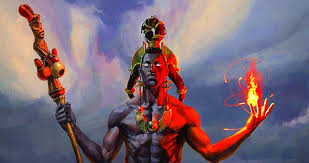
To those unfamiliar with Yoruba spirituality, Ẹ̀ṣù is sometimes wrongly portrayed as a figure of evil or chaos. Yet in traditional Yoruba belief, Ẹ̀ṣù is neither a devil nor an embodiment of wickedness. He is a messenger, a guardian of crossroads, and a divine examiner of human conduct.
His role is not to force people into wrongdoing but to reveal who they truly are.
Many Yoruba stories describe Ẹ̀ṣù as clever, unpredictable, and deeply insightful. He often appears when people least expect him, presenting situations that expose hidden truths about character, honesty, pride, greed, and wisdom.
One of the most famous tales associated with him is the story of how he tested two friends and revealed the fragile nature of human judgement.
It is a story that has been told for generations, not merely as entertainment, but as a lesson about perception, humility, and the dangers of assuming that one's own view is the only truth.
Two Friends, One Bond
Long ago, in a peaceful Yoruba village, there lived two farmers.
They were not merely neighbours. They were close friends whose bond was admired by everyone around them.
They worked together during planting season.
They helped each other during harvest.
They attended ceremonies together and shared meals beneath the shade of large trees.
Whenever villagers spoke of friendship, they often pointed to these two men as an example.
"If friendship has a face," people would say, "it looks like theirs."
The two friends took great pride in their relationship. They believed nothing could ever come between them.
But far away, Ẹ̀ṣù heard these boasts.
And he became curious.
Was their friendship truly as strong as they claimed?
Or had it simply never been tested?
Ẹ̀ṣù's Curious Plan
One morning, Ẹ̀ṣù decided to find out.
He crafted a remarkable hat unlike any the village had ever seen.
One side of the hat was bright red.
The other side was deep black.
From one angle, it appeared entirely red.
From another, entirely black.
Satisfied with his creation, Ẹ̀ṣù set off towards the village.
As fate would have it, the two friends were working in neighbouring fields separated by a narrow path.
Without speaking to either man, Ẹ̀ṣù calmly walked between them along the path.
The farmer on the left saw only the red side of the hat.
The farmer on the right saw only the black side.
Neither realised that the hat had two colours.
After passing between them, Ẹ̀ṣù disappeared down the road.
The test had begun.
The Argument Begins
Later that day, one of the farmers remarked:
"Did you see the traveller who passed by this morning? His red hat was quite unusual."
His friend looked puzzled.
"Red hat? What are you talking about? The hat was black."
The first farmer laughed.
"You must not have been paying attention. It was clearly red."
The second farmer shook his head.
"No, my friend. It was black. I saw it with my own eyes."
At first, the disagreement seemed harmless.
But neither man was willing to reconsider.
Each trusted his own perspective completely.
Each believed he could not possibly be wrong.
The conversation grew heated.
Voices rose.
Accusations followed.
Before long, the two friends who had once worked side by side were shouting at one another in anger.
Pride Takes Control
As the argument intensified, pride began to replace reason.
Neither man paused to consider that the other might have seen something different.
Neither asked questions.
Neither sought understanding.
Instead, each became more determined to prove himself right.
What had started as a simple disagreement soon threatened to destroy years of friendship.
The villagers gathered to watch.
Some sided with one farmer.
Others sided with the other.
The entire community became divided over an argument that neither side fully understood.
And all the while, Ẹ̀ṣù watched.
The Revelation
Just when the dispute seemed beyond repair, Ẹ̀ṣù returned.
Approaching the crowd, he asked what had caused such commotion.
The villagers eagerly explained.
One group insisted the traveller's hat had been red.
The other insisted it had been black.
After listening carefully, Ẹ̀ṣù smiled.
Then he removed the hat from his head and held it before them.
Gasps spread through the crowd.
The villagers could now see what the two friends had failed to realise.
One side of the hat was red.
The other side was black.
Both men had been telling the truth.
And yet both had been wrong.
They were correct about what they had seen, but mistaken in believing that their perspective represented the whole truth.
The argument ended instantly.
The two friends looked at one another with embarrassment and regret.
Years of trust had nearly been destroyed because neither had considered that another viewpoint might exist.
The Lesson of Ẹ̀ṣù
The villagers expected Ẹ̀ṣù to laugh at them.
Instead, he spoke calmly.
He explained that human beings often become trapped by their own perspectives.
People see part of a situation and assume they see all of it.
They hear one side of a story and believe they know the entire truth.
They become so certain of their own understanding that they stop listening to others.
This, Ẹ̀ṣù warned, is how conflicts begin.
The lesson was not about hats.
It was about character.
It was about humility.
It was about recognising that wisdom often begins with acknowledging the limits of one's own knowledge.
Why Ẹ̀ṣù Tests Humanity
In Yoruba tradition, Ẹ̀ṣù frequently appears at crossroads, both literal and symbolic.
A crossroads represents choice.
Every day, people face decisions that reveal who they truly are.
Will they choose honesty or deception?
Patience or anger?
Humility or pride?
Understanding or judgement?
Ẹ̀ṣù's role is often to present circumstances that bring these choices into the open.
He does not create human character.
He reveals it.
The tests he presents allow people to see themselves more clearly.
A Lesson for the Modern World
Although this story is centuries old, its message remains remarkably relevant.
Modern societies continue to experience disagreements driven by incomplete information, assumptions, and unwillingness to consider alternative perspectives.
Families argue.
Communities become divided.
Nations clash.
Often, the root cause is the same lesson taught by Ẹ̀ṣù's two coloured hat.
People mistake their view for the entire truth.
The story encourages curiosity instead of certainty, listening instead of immediate judgement, and understanding instead of pride.
These lessons remain as valuable today as they were in ancient Yorubaland.
Conclusion
The story of Ẹ̀ṣù and the test of human character is one of the most profound moral tales in Yoruba tradition. Through a simple encounter involving two friends and a two coloured hat, it reveals a timeless truth about human nature.
Ẹ̀ṣù did not seek to create conflict. He sought to expose the weaknesses that already existed beneath the surface: pride, stubbornness, and the assumption that one's own perspective is complete.
The tale reminds us that wisdom requires humility and that truth is often larger than any single point of view.
For generations, Yoruba storytellers have shared this narrative as a lesson in character, reminding listeners that before judging others, they should first consider the possibility that they may be seeing only one side of the hat.
And perhaps that is the greatest lesson of all: understanding begins when we recognise that our own eyes do not always see the whole picture.