Introduction
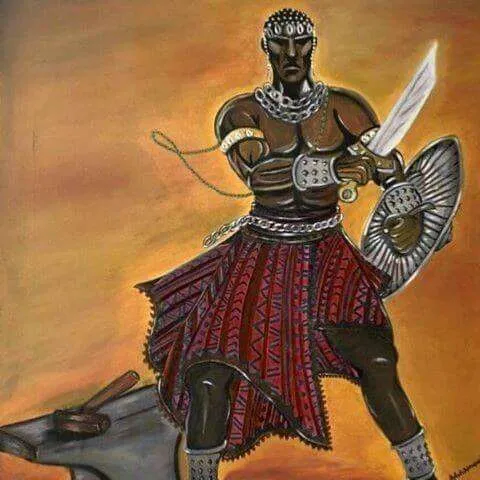
Among the most celebrated narratives in Yoruba spirituality is the story of Ògún and his role in opening the path between the spiritual and physical worlds. It is a story of courage, sacrifice, perseverance, and the transformative power of hard work.
In Yoruba tradition, Ògún is not merely the Òrìṣà of iron. He is the pioneer, the pathfinder, the one who ventures where others fear to go. Whenever obstacles stand between humanity and progress, it is Ògún who clears the way.
His story explains why he is honoured as the patron of blacksmiths, hunters, warriors, farmers, engineers, artisans, and all who rely upon tools and technology to transform their environment.
More importantly, it teaches a timeless lesson: every achievement requires someone willing to confront difficulty and create a path where none previously existed.
The World Before the Path Was Opened
According to Yoruba cosmology, there was a time when communication between Ọ̀run, the spiritual realm, and Ayé, the physical world, was not fully established.
The primordial Òrìṣà had been entrusted by Olódùmarè with the responsibility of organising the earth and making it suitable for human habitation.
However, a major obstacle stood in their way.
Between Ọ̀run and Ayé lay a vast wilderness.
The route was blocked by dense forests, tangled vegetation, rocky terrain, and powerful spiritual barriers.
The path was impassable.
Without access, the work of creation could not proceed effectively.
The Òrìṣà gathered to discuss the problem.
Many possessed extraordinary powers, but none could overcome the obstacle before them.
The wilderness remained unconquered.
The Challenge Before the Òrìṣà
As the Òrìṣà debated how to proceed, it became clear that the challenge required more than wisdom or authority.
It required action.
Someone had to enter the wilderness.
Someone had to confront the unknown.
Someone had to create a road through the chaos.
The task was dangerous.
The forest was filled with obstacles.
The terrain was unforgiving.
Failure seemed likely.
Yet without a path, progress would remain impossible.
Ògún Accepts the Mission
While others hesitated, Ògún stepped forward.
Armed with his iron implements and unmatched determination, he volunteered to undertake the mission.
This decision reflected one of the defining characteristics of Ògún.
He does not wait for circumstances to become easy.
He confronts challenges directly.
With his tools in hand, he entered the wilderness.
The journey was difficult.
Trees blocked his way.
Thorns tore at his body.
Rocks obstructed his progress.
Yet he continued.
Step by step.
Cut by cut.
Stroke by stroke.
He carved a route through the dense forest.
The Power of Iron
The success of Ògún's mission was made possible by iron.
In Yoruba thought, iron represents transformation.
Raw nature becomes useful through tools.
Chaos becomes order through labour.
Potential becomes reality through effort.
Ògún's iron implements symbolise humanity's ability to shape the world through skill and determination.
His machete did more than cut vegetation.
It transformed impossibility into possibility.
This is why iron occupies such a sacred place in Yoruba culture.
Without iron, there could be no farming tools, hunting weapons, building implements, or technologies that support civilisation.
The Opening of the Path
After immense effort, Ògún succeeded.
The wilderness was opened.
A clear route now connected Ọ̀run and Ayé.
The other Òrìṣà could travel safely.
The work of creation could continue.
Humanity could eventually flourish.
The achievement transformed Ògún into one of the most respected figures among the Òrìṣà.
He became known as the one who opens roads, removes obstacles, and creates opportunities where none previously existed.
The path he created was not only physical.
It was symbolic.
It represented the removal of barriers that prevent growth and progress.
Why Ògún Is Called the Pathfinder
Because of this achievement, Ògún became associated with every form of breakthrough.
Whenever a road is built, his influence is remembered.
Whenever land is cleared for cultivation, his presence is acknowledged.
Whenever a craftsman shapes metal into useful tools, his legacy continues.
He is revered as:
* The opener of roads * The master of iron * The patron of labour * The pioneer of civilisation * The conqueror of obstacles
His story reminds people that every advancement begins with someone willing to do difficult work.
The Deeper Meaning of the Wilderness
The wilderness in the story is not only a physical forest.
It also symbolises:
* Fear * Uncertainty * Ignorance * Challenges * Limitations
Every person encounters their own wilderness in life.
Students face educational challenges.
Entrepreneurs confront business difficulties.
Artists struggle with creative obstacles.
Communities face social problems.
The story teaches that progress occurs when individuals face these challenges rather than avoid them.
The Moral Lessons of the Story
The story of Ògún contains several important lessons.
Courage Creates Opportunity
Many people recognise problems.
Few volunteer to solve them.
Ògún teaches that courage often distinguishes leaders from observers.
Hard Work Produces Results
The path was not opened through wishes or words alone.
It required sustained effort.
Success demands labour.
Obstacles Can Be Overcome
No matter how dense the forest appeared, persistence eventually created a way through it.
Challenges are rarely permanent.
Tools and Knowledge Matter
Ògún's success depended upon his mastery of iron.
Skill and preparation increase the likelihood of success.
Progress Benefits Everyone
The path Ògún created was not for himself alone.
It benefited the entire community.
True achievement often serves others as well as oneself.
Ògún and Modern Society
The symbolism of Ògún remains remarkably relevant today.
In modern times, his influence is often associated with:
* Engineering * Transportation * Manufacturing * Construction * Technology * Innovation
Every bridge, railway, vehicle, machine, and tool reflects the transformative power represented by Ògún.
He remains a symbol of human ingenuity and the ability to reshape the world through effort and skill.
Ògún in the Yoruba Diaspora
The reverence for Ògún travelled across the Atlantic during the transatlantic slave trade.
Today, he continues to be honoured in:
* Nigeria * Benin * Togo * Cuba * Brazil * Haiti * Trinidad and Tobago * The United States
Across these regions, he remains a powerful symbol of strength, work, protection, and perseverance.
Conclusion
The story of Ògún and the opening of the path is one of the foundational narratives of Yoruba spirituality. It celebrates the courage required to confront obstacles and the determination needed to create opportunities.
When others hesitated before the wilderness, Ògún stepped forward. Through skill, labour, and perseverance, he transformed an impossible situation into a pathway for progress.
His story reminds us that every road, whether physical or symbolic, begins with someone willing to clear the way. Success rarely comes without effort, and breakthroughs rarely occur without courage.
For this reason, Ògún remains one of the most respected Òrìṣà in Yoruba tradition, the eternal pathfinder whose iron tools continue to symbolise humanity's capacity to overcome challenges and build a better world.