Before the Earth Existed
Long before mountains rose from the ground, before rivers carved their paths through the forests, and before human beings walked beneath the sun, there was only the vast expanse of existence itself.
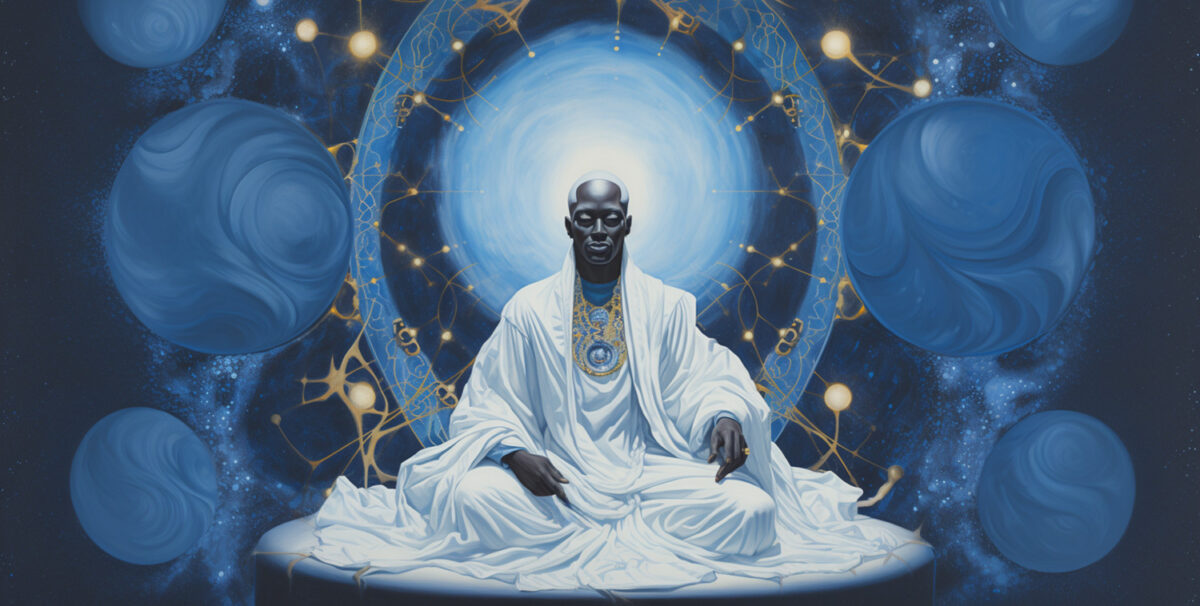
In the beginning, according to Yoruba tradition, the universe was not as we know it today. There was no dry land, no villages, no kingdoms, and no people. The world below was covered entirely by endless waters stretching beyond sight. Above this watery realm was the heavenly kingdom, known as Òrun, the dwelling place of the Supreme Being, Olódùmarè.
Olódùmarè was the source of all life, all wisdom, and all power. Unlike kings who ruled over territories or warriors who conquered enemies, Olódùmarè needed no throne to prove His authority. He existed before all things and possessed the knowledge of everything that was, is, and would ever be.
The heavens were filled with divine beings known as the Òrìṣà, spiritual messengers and custodians of various aspects of creation. They lived in harmony under the authority of Olódùmarè, carrying out sacred duties throughout the celestial realm.
Yet beneath the heavens, the waters remained empty and untouched.
Then came the moment that would change everything.
Olódùmarè's Great Decision
One day, Olódùmarè looked upon the endless waters below and decided that a new world should be created.
A world where life could flourish.
A world where trees would grow, animals would roam, and human beings would one day build communities and tell stories of their ancestors.
To accomplish this sacred task, Olódùmarè summoned one of the most respected divine beings, Ọbàtálá, the Òrìṣà associated with wisdom, purity, and creation.
When Ọbàtálá appeared before the Supreme Being, he listened carefully as Olódùmarè entrusted him with an extraordinary mission.
He was given a golden chain long enough to reach from heaven to the waters below. Alongside it, he received a sacred snail shell containing earth, a white hen, a pigeon, and other divine objects necessary for creation.
His instructions were simple yet profound.
Descend to the waters and create the world.
The Journey from Heaven
With great honour and responsibility, Ọbàtálá began his journey.
Holding the sacred gifts entrusted to him, he climbed down the golden chain that stretched from heaven towards the vast ocean below. The divine beings watched as he descended into the unknown.
But along the way, events took an unexpected turn.
Some versions of the ancient story tell that Ọbàtálá became distracted and failed to complete the mission. Seeing this, another powerful divine figure, Odùduwà, stepped forward and took up the responsibility of creation.
Whether one follows the tradition that credits Ọbàtálá or the one that places Odùduwà at the centre of the story, the purpose remained the same: the creation of the earth under the authority of Olódùmarè.
The Birth of Dry Land
Upon reaching the watery world below, Odùduwà carefully opened the sacred snail shell.
Inside was a small quantity of earth.
To any ordinary observer, it would have seemed insignificant. How could such a small amount of soil transform an endless ocean?
Yet this was no ordinary earth.
Following the instructions of Olódùmarè, the soil was poured onto the surface of the waters.
Then the hen was released.
The bird began scratching and scattering the earth in every direction. It scratched forward and backward, spreading the soil across the waters. The pigeon joined in, helping to distribute the earth even further.
Slowly, the land expanded.
What had once been an endless ocean began to change.
Dry ground emerged.
Hills rose.
Valleys formed.
The foundations of rivers, forests, and plains appeared.
The first piece of land became known as Ile-Ife, often translated as "the place where the earth spread."
To the Yoruba people, Ile-Ife is not merely a city. It is regarded as the cradle of creation, the sacred birthplace of civilisation itself.
The Creation of Humanity
The world now had land, but it remained empty.
There were no voices, no laughter, and no communities.
Olódùmarè desired something more.
According to Yoruba tradition, the task of shaping humanity was entrusted to Ọbàtálá.
Using clay gathered from the newly formed earth, he carefully moulded human figures. He shaped their heads, their limbs, and their bodies with patience and skill.
Yet these figures remained lifeless.
Only Olódùmarè possessed the power to grant the breath of life.
When the figures were complete, Olódùmarè breathed life into them.
Their eyes opened.
Their hearts began to beat.
They stood and walked upon the earth.
Humanity had begun.
This belief explains why many Yoruba traditions regard human life as sacred. Every person carries within them the divine breath bestowed by Olódùmarè.
The World Takes Shape
As time passed, the earth became increasingly vibrant.
Forests spread across the land.
Animals filled the wilderness.
Rivers flowed through valleys.
The Òrìṣà carried out their responsibilities, helping to maintain balance within creation.
Human beings established settlements and communities. Families grew, traditions developed, and societies flourished.
From Ile-Ife, civilisation expanded across the land, eventually giving rise to the kingdoms, cities, and cultures that would become central to Yoruba history.
Throughout it all, Olódùmarè remained the supreme source of existence, watching over creation while allowing the world to unfold according to divine order.
The Meaning Behind the Story
Like many ancient creation narratives, the story of Olódùmarè and the beginning of creation is more than an explanation of how the world came into existence.
It expresses profound Yoruba beliefs about life, humanity, and the relationship between the divine and the earthly.
The story teaches that creation was intentional rather than accidental.
It emphasises cooperation between divine forces.
It highlights the sacredness of human life.
Most importantly, it affirms the belief that all existence originates from a supreme source whose wisdom surpasses human understanding.
Whether understood as spiritual truth, cultural heritage, or symbolic wisdom, the story continues to inspire generations of Yoruba people.
Conclusion
The story of Olódùmarè and the beginning of creation stands as one of the most treasured narratives in Yoruba tradition. It tells of a time when the world was nothing but water, when divine beings descended from heaven, and when sacred acts transformed emptiness into life.
At the heart of the story is Olódùmarè, the Supreme Creator whose vision brought order to chaos and life to a silent world.
For centuries, this tale has been passed from elders to children, from storytellers to listeners, preserving not only a creation story but also a profound understanding of humanity's place within the universe.
And so, whenever the story is told, it reminds us of a timeless Yoruba belief: that all life begins with divine purpose, and that the world itself is a gift shaped by the wisdom of Olódùmarè.