A Classic Yoruba Tale of Wit, Pride, and Consequence
In the quiet rhythm of old Yoruba villages, when evenings were lit by moonlight, and stories traveled from one generation to the next, there lived a tortoise whose name was known in every corner of the land. He was called Ijapa.
Ijapa was not admired for strength or beauty. He was slow, small, and carried his house upon his back. But what he lacked in physical gifts, he made up for with an extraordinary mind. He was clever in a way that often blurred the line between wisdom and mischief.
And it was this cleverness that led him into one of the most unforgettable tales ever told.
A Hunger That Sparked a Plan
There came a season when the land grew dry and food became scarce. Rivers shrank, fruits withered, and even the strongest animals struggled to find enough to eat.
One afternoon, as Ijapa wandered in search of something, anything, to satisfy his hunger, he overheard a gathering of birds. Their voices were bright with excitement. They spoke of a grand feast far above the earth, a celebration in the sky where food was said to be endless and rich beyond imagination.
Ijapa paused. His ears sharpened. His hunger deepened.
He knew immediately that he had to be part of that feast.
There was only one problem.
Ijapa could not fly.
Borrowed Wings
With careful steps and a humble expression, Ijapa approached the birds. He greeted them warmly and spoke with a softness that masked his true intentions.
“My friends,” he began, “you know these are difficult times. I have heard of your journey to the sky, and I ask, with respect, that you allow me to go with you.”
The birds hesitated. They knew Ijapa well. His reputation for trickery was no secret. Still, his voice carried a note of sincerity, and compassion stirred among them.
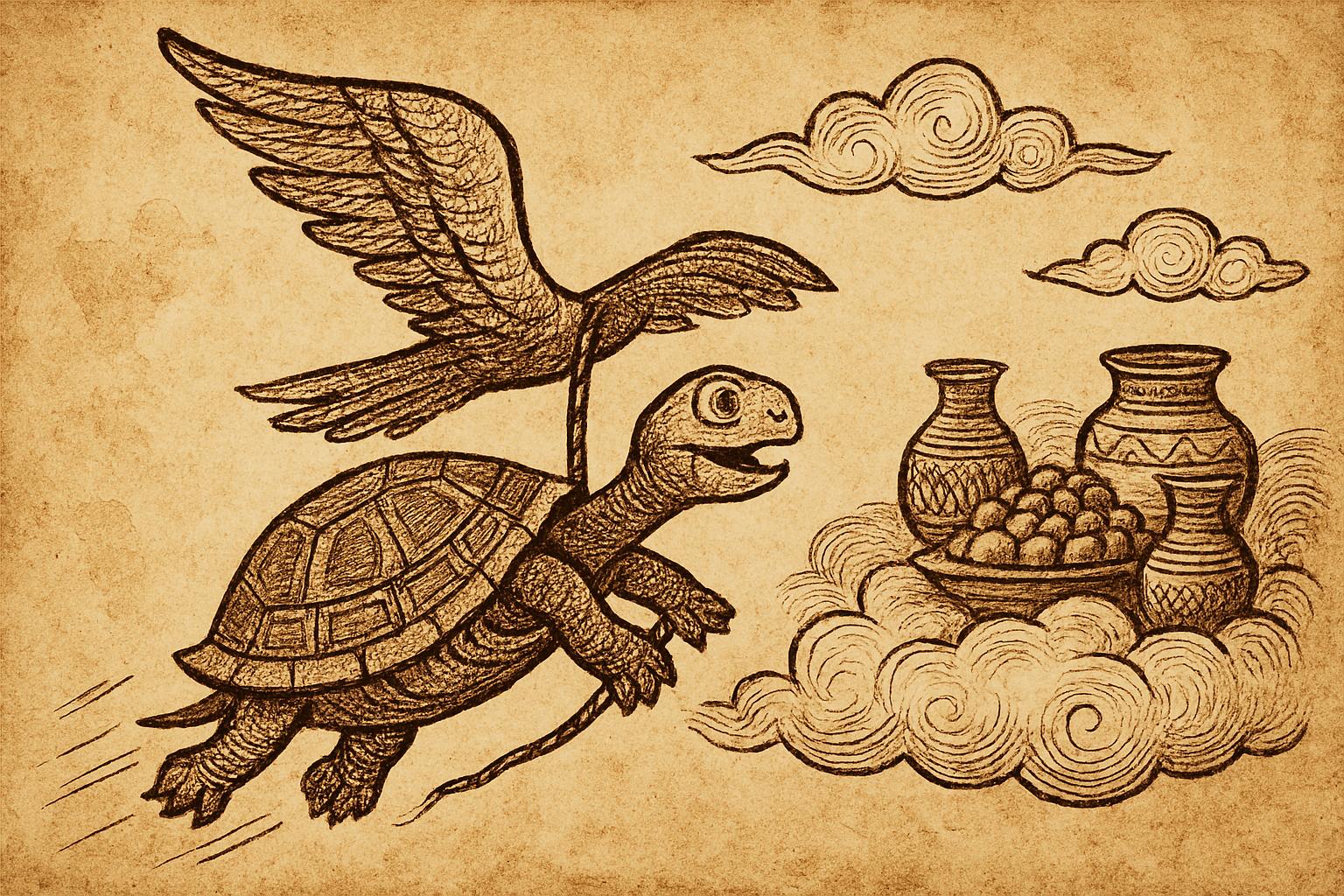
After some deliberation, they agreed to help him. Each bird would contribute a feather, and with those feathers, Ijapa would form wings strong enough to join them.
One by one, they plucked feathers and handed them to him. Ijapa accepted each gift with gratitude, carefully assembling them until he stood, for the first time, with wings of his own.
It was a moment that felt almost magical.
But Ijapa was already thinking ahead.
A Name with Hidden Meaning
Before the journey began, the birds followed an old custom. Each traveler would choose a name for the occasion, one that would be used throughout the feast.
When it was Ijapa’s turn, he smiled quietly.
“My name,” he said, “is All of You.”
The birds looked at one another, unsure of what to make of it. The name sounded strange, but they let it pass. After all, it was only a name.
Or so they thought
The Feast in the Sky
The journey to the sky was long, but at last they arrived.
What awaited them was more than they had imagined. Tables stretched endlessly, filled with food of every kind. The air carried music, laughter, and the warmth of celebration.
As the guests settled, the host of the feast stood and addressed them.
“This feast,” he announced with a welcoming smile, “is prepared for all of you.”
In that instant, Ijapa rose to his feet.
“You have heard him,” he declared. “My name is All of You. Therefore, this feast is meant for me.”
Before anyone could react, he began to eat.
He moved quickly, consuming dish after dish, leaving little behind. The birds watched in disbelief as their generosity was repaid with selfishness. By the time Ijapa finished, the abundance they had traveled so far to enjoy had nearly vanished.
The celebration fell silent.
The Quiet Justice of the Birds
The birds did not argue. They did not shout.
Instead, they acted.
One after another, they approached Ijapa and gently removed the feathers they had given him. Each bird reclaimed what was theirs, and with each feather returned, Ijapa’s borrowed wings disappeared.
When the last bird flew away, Ijapa stood alone in the sky, grounded and afraid.
For the first time, his cleverness had left him with no way out.
The Fall Back to Earth
Desperation took hold of him. Looking down at the distant earth, Ijapa realized the danger he faced.
He called out to a parrot who had not yet left. With a trembling voice, he begged for help.
“Please,” he said, “go to my home and tell my wife to prepare soft things. Let her lay out cloth, leaves, anything that will make my landing safe.”
The parrot agreed, but there was bitterness in its heart. When it delivered the message, it changed the words.
Instead of soft things, it told Ijapa’s wife to bring out hard objects.
Trusting the message, she arranged stones, pestles, and anything solid she could find.
Above, unaware of the change, Ijapa took a deep breath and jumped.
A Lesson Written in the Shell
He fell with great speed, cutting through the air until he struck the ground below.
The impact was devastating. His shell shattered into pieces, breaking apart under the force of the fall.
In pain and regret, Ijapa lay still as his wife rushed to him. With care and urgency, she gathered the broken pieces and sought help to mend them.
The shell was put back together, but it was never the same again.
The cracks remained.
And so, the elders say, that is why the tortoise’s shell is patterned with lines to this day.
The Meaning Behind the Tale
The story of Ijapa and the birds is not merely a tale of trickery. It is a reflection of human nature, told through the voice of tradition.
It speaks of ambition without restraint, of intelligence without integrity, and of the consequences that follow when trust is broken.
Ijapa’s cleverness brought him opportunity, but his greed led to his downfall. The kindness of the birds was repaid with selfishness, and in the end, balance was restored through quiet justice.
In Yoruba storytelling, lessons are rarely forced. They unfold naturally, leaving the listener to reflect.
And in this story, the lesson is clear.
A clever mind is a gift, but without character, it can become a burden.
Moral of the story
Greed and deception ultimately lead to one's downfall.