Introduction
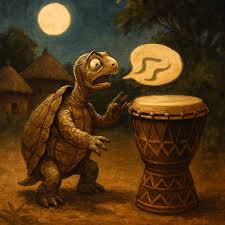
Among the most memorable characters in Yoruba storytelling is Ìjàpá, the tortoise. Clever, curious and often mischievous, Ìjàpá appears in many Yoruba folktales as a character whose intelligence can be used either for good or for selfish purposes.
One of the enduring themes associated with tortoise stories is the danger of allowing cleverness to become arrogance. In this tale, Ìjàpá encounters one of the most remarkable objects in Yoruba cultural life, the talking drum. What begins as curiosity gradually becomes a lesson about knowledge, responsibility and the consequences of trying to control something that belongs to the wider community.
It is important to note that Yoruba folktales were traditionally transmitted orally. Consequently, stories can exist in different versions, with storytellers changing characters, events and details while preserving the central moral lesson. The story presented here is therefore best understood as a Yoruba inspired retelling rather than a claim that there is only one original historical version.
The Village and the Mysterious Drum
Long ago, in a Yoruba town surrounded by farms, palm trees and busy marketplaces, there lived a tortoise known as Ìjàpá.
Ìjàpá was famous throughout the town for his cleverness. Unfortunately, he was also known for using his intelligence to gain advantages over other animals and people.
Whenever the villagers gathered to celebrate a festival, Ìjàpá was there.
Whenever food was shared, he somehow appeared.
Whenever elders discussed an important matter, Ìjàpá listened carefully from a distance, hoping to discover something that might benefit him.
One afternoon, while walking near the palace, Ìjàpá heard a sound unlike anything he had heard before.
Boom.
The sound travelled through the town.
Boom.
It seemed almost as though someone was speaking through music.
Ìjàpá followed the sound until he reached the palace courtyard.
There he saw a skilled drummer playing a dùndún.
The drum was shaped like an hourglass and had cords running along its wooden body. The drummer held it beneath his arm and used a curved stick to strike the drum while squeezing the cords with his other hand.
To Ìjàpá's amazement, the pitch changed as the drummer tightened and relaxed the cords.
The drum seemed to speak.
How the Talking Drum Really Works
The talking drum is not magical in the literal sense. Its remarkable ability comes from its design and from the skill of the drummer.
The Yoruba dùndún is a pressure drum. Its cords connect the two drumheads, and the drummer can change the tension by pressing the cords beneath the arm. This changes the pitch of the drum.
Because Yoruba is a tonal language, changes in pitch can carry meaning. A highly skilled drummer can therefore reproduce patterns that resemble the tones and rhythms of spoken Yoruba. Researchers have described the dùndún as both a musical instrument and a speech surrogate.
The instrument has therefore served purposes beyond entertainment. Yoruba drummers have historically performed praise poetry, communicated messages, accompanied ceremonies and preserved historical and cultural knowledge.
For Ìjàpá, however, the most interesting thing was not the music.
It was the possibility of discovering a secret.
Ìjàpá Wants to Know the Secret
After the performance, Ìjàpá approached the drummer.
“Tell me,” he asked, “how does the drum speak?”
The drummer smiled.
“A drum does not speak by itself. It speaks through the knowledge and skill of the person who plays it.”
Ìjàpá was not satisfied.
“Then teach me.”
The drummer shook his head.
“To learn the drum, you must first learn patience. You must understand the language, the rhythms, the poetry and the traditions behind the music.”
But Ìjàpá wanted an easier path.
He wanted the secret without the discipline.
He watched the drummer carefully and began copying what he saw.
For many days, Ìjàpá secretly observed the drummer. He watched how the drummer held the instrument. He watched how the cords were squeezed. He listened to the rhythms.
Eventually, he began to imitate some of the sounds.
Ìjàpá became convinced that he had discovered the secret of the talking drum.
But he had learned only part of the knowledge.
The Secret Is More Than the Sound
One evening, Ìjàpá found himself alone with the drum.
He struck it.
Boom.
He squeezed the cords.
The pitch changed.
He tried again.
Boom.
The sound travelled across the courtyard.
Ìjàpá became excited.
He believed he had gained a special power.
He began telling the other animals that he could make the drum reveal hidden information.
Soon, animals came to him with questions.
Who had taken the missing food?
Who had entered the farm?
Who had spoken about them?
Who had broken a promise?
Ìjàpá claimed that the drum knew everything.
The animals believed him.
Before long, Ìjàpá began charging them for answers.
His reputation grew.
People travelled from neighbouring communities because they had heard about the tortoise who possessed a mysterious drum.
But there was one problem.
The drum did not actually reveal people's private thoughts.
Ìjàpá was simply using the mystery surrounding the instrument to make himself appear powerful.
When Cleverness Becomes Deception
For some time, Ìjàpá enjoyed his success.
He collected food and gifts from people who came to him.
He began believing that he was more intelligent than everyone else.
Then one day, an elderly drummer visited the town.
The old drummer listened carefully to Ìjàpá's performance.
Afterwards, he said nothing.
Instead, he asked Ìjàpá to play a particular rhythm.
Ìjàpá tried.
The sound was wrong.
The drummer asked him to reproduce a traditional praise phrase.
Again, Ìjàpá failed.
Finally, the old drummer asked him to explain the meaning of the rhythm he had played.
Ìjàpá had no answer.
The old man turned to the people gathered around them.
“This is not the secret of the talking drum,” he said. “The sound is only one part of the knowledge. The drummer must understand the language, the poetry, the history and the occasion.”
The people suddenly understood what had happened.
Ìjàpá had mistaken imitation for knowledge.
The Truth About the Talking Drum
The story reflects an important reality about Yoruba drumming traditions.
The dùndún is part of a wider musical and oral tradition. Skilled drummers do not simply produce random sounds. Their performances can contain praise poetry, historical references, names, proverbs and messages that are understood within their cultural context.
Academic research has described Yoruba talking drummers as important repositories of historical, social, ethical and religious knowledge.
The tradition also involves specialised learning. Research on Yoruba dùndún musicians has found that knowledge is transmitted through observation, participation, modelling and verbal instruction.
This makes the drum more than an instrument.
It becomes a vessel through which knowledge can be remembered and transmitted.
Ìjàpá Learns His Lesson
The elderly drummer looked at Ìjàpá.
“You wanted the secret of the drum,” he said. “But the real secret was never hidden inside the wood.”
Ìjàpá lowered his head.
“The secret is in the knowledge of the people who understand it.”
For the first time, Ìjàpá realised that his mistake was not wanting to learn.
His mistake was wanting power without responsibility.
He had taken something that belonged to a cultural tradition and tried to turn it into a tool for personal gain.
The people stopped coming to him for mysterious answers.
The drummer, however, offered him another opportunity.
“If you truly want to learn,” he said, “then begin again.”
This time, Ìjàpá agreed.
He listened.
He observed.
He asked questions.
He practised.
Most importantly, he learned to respect the knowledge behind the instrument.
Why the Talking Drum Matters in Yoruba Culture
The dùndún has a long and important place in Yoruba cultural life.
Research describes it as one of the most characteristic forms of Yoruba traditional drumming. It has been used in both religious and secular settings, including royal ceremonies, praise performance and other social occasions.
The lead drum in a dùndún ensemble is known as the ìyáàlù, meaning “mother of the drums”. It is particularly expressive because its pitch can be altered through the pressure applied to the tension cords.
The term “talking drum” can sometimes give the impression that the instrument literally speaks human words. In reality, its ability to imitate the tonal patterns of speech is what gives it this reputation.
This distinction matters because the true achievement lies in the drummer's cultural and musical knowledge.
A drum may produce sound.
A skilled drummer gives that sound meaning.
The Deeper Meaning of Ìjàpá's Story
Like many Yoruba tortoise stories, this tale can be understood on several levels.
The first lesson concerns curiosity.
Curiosity can lead to discovery, but it must be accompanied by patience and humility.
The second lesson concerns knowledge.
Knowing how something works is not necessarily the same as understanding it. Ìjàpá learned how to produce certain sounds, but he did not initially understand the cultural knowledge behind them.
The third lesson concerns power.
Knowledge can give people influence, but influence carries responsibility. When knowledge is used to deceive others, cleverness becomes dangerous.
The final lesson concerns humility.
The person who believes that he already knows everything leaves no room for learning.
Why Tortoise Stories Remain Important
Ìjàpá is one of the best known figures in Yoruba oral storytelling.
Tortoise stories often use humour, trickery and exaggerated situations to teach serious lessons about human behaviour. The tortoise may be intelligent, but his intelligence frequently creates problems because he is greedy, impatient or overconfident.
This makes Ìjàpá an entertaining character while also allowing storytellers to explore difficult questions about human nature.
Children can enjoy the humour.
Adults can recognise the deeper warnings.
That is one of the strengths of oral tradition.
A simple story can carry several generations of wisdom.
Oral Tradition and the Preservation of Yoruba Heritage
Stories such as this one also demonstrate why Yoruba oral tradition is so important.
Before modern recording technologies, communities relied heavily on memory, performance and repeated storytelling to transmit knowledge.
Drummers, elders, praise singers, priests, parents and storytellers all contributed to the preservation of history and cultural values.
The dùndún tradition itself is closely connected to this broader culture of oral expression. Scholars have noted that talking drummers have historically played important roles in Yoruba social, religious and political life.
Through performance, generations could remember names, achievements, histories, moral principles and cultural identities.
The talking drum therefore represents more than sound.
It represents memory.
The Moral of the Story
The greatest secret of the talking drum is not that it can imitate speech.
The greatest secret is that sound becomes meaningful when it is guided by knowledge.
Ìjàpá wanted the power of the drum without understanding the responsibility behind it. His mistake teaches us that intelligence without wisdom can lead to deception, while knowledge combined with humility can become a gift to an entire community.
The story also reminds us that cultural knowledge should be respected rather than treated merely as a source of personal advantage.
Conclusion
“The Tortoise and the Secret of the Talking Drum” brings together two important elements of Yoruba heritage: Ìjàpá, the clever tortoise of Yoruba folklore, and the dùndún, one of the most remarkable instruments in Yoruba musical culture.
Although folktales can exist in many versions, their central lessons often remain remarkably consistent. They teach about wisdom, greed, humility, responsibility and the consequences of abusing knowledge.
The talking drum itself is not simply a mysterious object from a folktale. It is a real cultural instrument with a sophisticated design and a long history within Yoruba society. Its ability to reproduce aspects of Yoruba speech demonstrates the close relationship between language, music and oral tradition.
And perhaps that is the greatest lesson Ìjàpá eventually learns.
Knowledge is not truly powerful because it is hidden.
It is powerful because it is understood, respected and passed on responsibly.
For generations, Yoruba storytellers have used characters such as Ìjàpá to teach this kind of wisdom. Today, retelling these stories in new forms can help ensure that the imagination, humour and moral philosophy of Yoruba oral tradition continue to reach new generations.