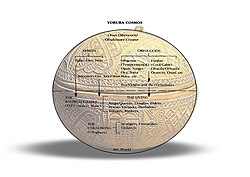
In Yoruba thought, reality is not a single flat world—it is a layered, living cosmos shaped by relationship, destiny, and divine order. At the center of this worldview are two inseparable realms:
* Ọ̀run (the spiritual realm, often translated as “heaven”) * Ayé (the physical world, “earth” or lived existence)
But in Yoruba philosophy—especially as preserved in Ifá—these are not distant, disconnected places. They constantly interact, overlap, and influence one another in ways that shape human destiny, morality, and experience.
Understanding Ọ̀run and Ayé is essentially understanding how Yoruba people explain life itself.
Ọ̀run: The Invisible, Structured Spiritual Realm
In Yoruba cosmology, Ọ̀run is not a vague “sky heaven.” It is a highly organized spiritual dimension where divine forces, ancestors, and pre-birth destinies exist.
Ọ̀run is home to:
* Olódùmarè, the Supreme Source of existence * The Òrìṣà (divine forces governing natural and moral order) * The ancestors (Ẹ̀gún) Human destinies (Orí*) before birth
In Ifá teachings, Ọ̀run is often described as:
* Invisible but real * Structured, not chaotic Governed by divine order (Àṣẹ*) * The origin point of human destiny
One key idea is that nothing in Ayé begins without first existing in Ọ̀run.
Ayé: The Physical World of Experience and Becoming
Ayé is the world humans inhabit—the world of change, time, growth, struggle, and achievement.
Unlike Ọ̀run, Ayé is:
* Physical and visible * Temporary and changing * Full of duality (joy and suffering, success and failure) * The space where destiny unfolds
If Ọ̀run is the place of origin, then Ayé is the place of expression.
In Yoruba thought, life in Ayé is not random. It is deeply connected to what was chosen in Ọ̀run before birth.
The Bridge Between Ọ̀run and Ayé
One of the most important teachings in Ifá philosophy is that there is no strict separation between heaven and earth.
Instead, they are connected through:
1. Orí (Personal Destiny)
Before entering Ayé, every person selects an Orí in Ọ̀run.
Orí means:
* Inner head (spiritual consciousness) * Personal destiny * Inner guide
It is said:
> “Orí ẹni ni báni gbé” — “One’s Orí is the true companion.”
If your Orí is aligned, life flows smoothly. If it is misaligned, even effort may struggle.
2. Àṣẹ (Divine Power of Realization)
Àṣẹ is the spiritual energy that makes things happen.
It flows from Ọ̀run into Ayé and allows:
* Speech to become reality * Rituals to work * Destiny to manifest * Life itself to continue
Without Àṣẹ, nothing in the universe functions.
3. Òrìṣà (Divine Intermediaries)
The Òrìṣà act as bridges between both realms.
They:
* Carry messages between Ọ̀run and Ayé * Govern natural forces (river, iron, wind, fertility, justice, etc.) * Help humans align with destiny
For example:
* Ṣàngó represents justice and cosmic balance * Yemoja represents nurturing, oceanic life force
Through devotion, humans maintain harmony with these forces.
Death: Returning from Ayé to Ọ̀run
In Yoruba belief, death is not the end of existence—it is a transition.
When a person dies:
* Their body returns to earth (Ayé) * Their spirit returns to Ọ̀run * Their legacy continues through memory and lineage
However, Ifá teaches that the quality of one’s life in Ayé influences how they are received in Ọ̀run.
This is why moral conduct (Ìwà Pẹ̀lẹ́) is so important.
The Role of Ancestors (Ẹ̀gún)
Ancestors occupy a special position between Ọ̀run and Ayé.
They are:
* Humans who lived in Ayé * Now existing in Ọ̀run * Still active in family and community life
They are not distant or silent. They are remembered, honoured, and consulted.
Through rituals and remembrance, the boundary between realms becomes porous.
Ọ̀run and Ayé Are a Continuous Cycle
Yoruba cosmology does not see existence as linear (beginning → end).
Instead, it is cyclical:
Some traditions also speak of Atunwá (rebirth), where ancestors may return into families through newborns.
Moral Philosophy: Living Well in Ayé
Ifá emphasizes that the purpose of life in Ayé is not merely survival or success, but alignment with destiny.
Core principles include:
* Ìwà Pẹ̀lẹ́ (gentle, good character) * Respect for community and elders * Responsibility toward one’s Orí * Balance between material and spiritual life
A person may be wealthy but still considered spiritually unsuccessful if their character is lacking.
Modern Interpretation and Cultural Continuity
Today, the Yoruba concept of Ọ̀run and Ayé continues to influence:
* Traditional religion and Ifá practice * Christianity and Islam in Yoruba society (often blended cosmologically) * Yoruba philosophy and ethics * Diasporic religions like Candomblé and Santería
Even when terminology changes, the idea of a connected spiritual and physical world remains deeply rooted.
Conclusion
In Yoruba thought, Ọ̀run and Ayé are not separate worlds—they are two dimensions of a single reality.
Ọ̀run is the source: where destiny is formed, where divine order exists, where the invisible becomes structured meaning.
Ayé is the expression: where destiny unfolds, where life is experienced, where character is tested.
And between them flows Orí, Àṣẹ, and the guiding presence of the Òrìṣà.
To live well in Yoruba philosophy is to live in harmony with both realms—walking carefully on earth while staying spiritually aligned with heaven.